
This article was first published on APTN News.
In Canada: The Essipit Innu First Nation says it won’t allow mining exploration in a protected area on its territory.
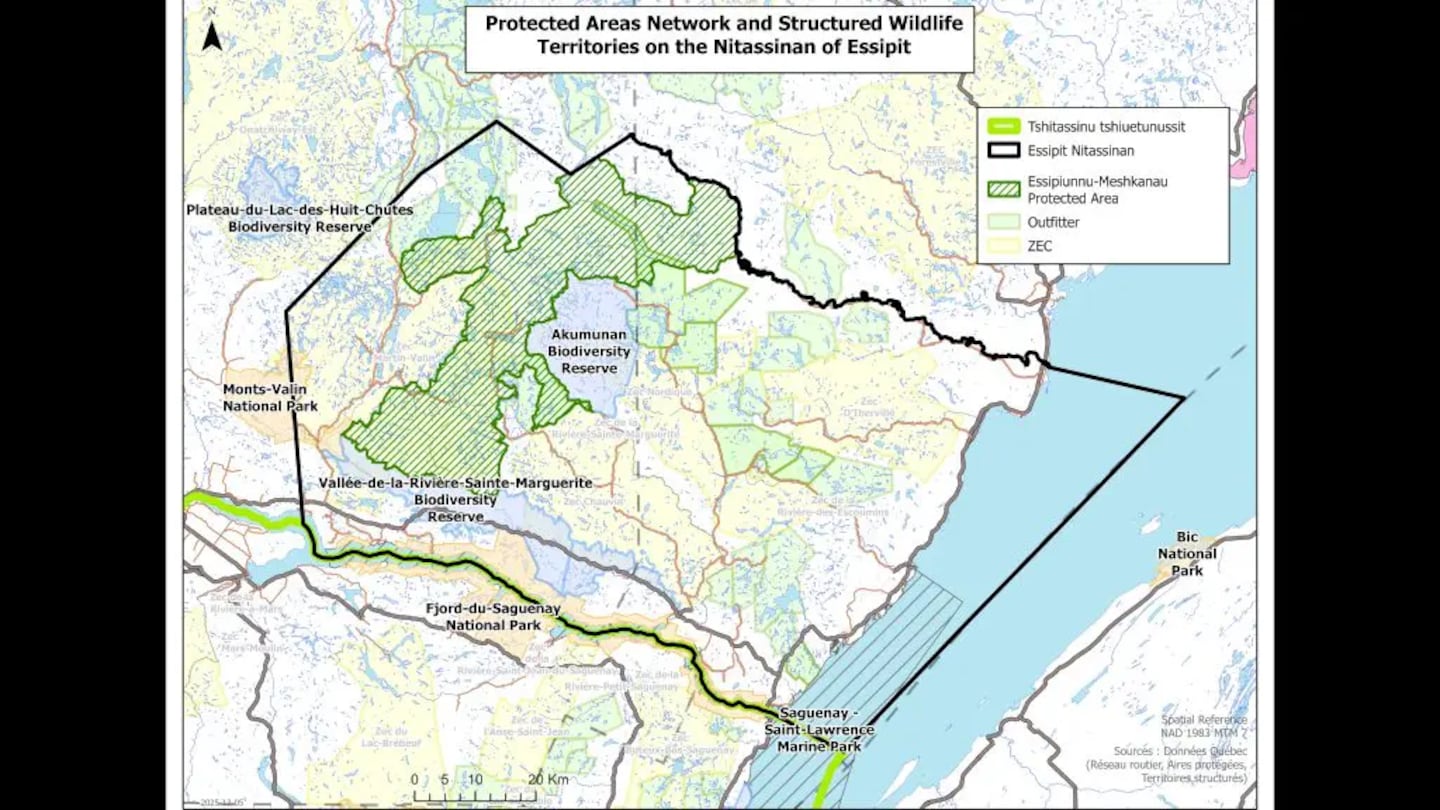
On Dec. 9, the leadership announced in a press release that it wants developers to stay out of the Essipiunnu-Meshkanau Protected Area, a self-designated 1,200 km section of their Nitassinan (“homeland”) north of the intersection of the St-Lawrence River and the Saguenay Fjord.
“We reaffirm our commitment to maintaining a balance between development and the protection of the territory and biodiversity,” the Essipit Council wrote in the release. “We therefore require all developers and stakeholders working in the mining sector to meet with our First Nation before designating exclusive exploration rights (formerly referred to as claims) on Nitassinan or before beginning any project requiring our consent.”
In late November 2023, Essipit’s chief and council announced the creation of the protected area, which aimed to safeguard the region’s natural environment and preserve biodiversity, and habitat for caribou in particular.
But a representative from Essipit said they were not looking to make enemies with mining companies. Rather, they’re interested in discussing partnerships for mining projects located elsewhere in the Nitassinan, while leaving the Essipiunnu-Meshkanau Protected Area untouched.
“The protected area zone is closed to mining exploration,” said Michael Ross, Essipit’s director of territory and development. “However, elsewhere in the territory, we are open to seeing if there are opportunities for collaboration. That is really the priority.”
These positions represent the two prongs of Essipit’s approach toward mining at a time when interest in minerals beneath the Nitassinan is proliferating.
“In recent years, with the various initiatives of the Quebec government, there has been a craze for mining claims with the appeal of rare-earth and other minerals,” Ross said.
“We are really seeing a craze among mining exploration companies claiming land, particularly within our protected land project.”
Essipit announced its prohibition on mining exploration in the protected area after watching claims staked in that area double since 2024.“We’ve gone from about 100 mining claims to 210 in the last year,” Ross told APTN News. “The craze for everything related to rare earth has really taken off in the last year. And we’ve suffered the consequences of that craze.”
Even at the level of exploration, Ross said mining work can have an enormous impact on the land.
“It could involve building roads, stripping, cutting down trees, to get down and drill and collect data on what’s inside the earth,” he said. “From our perspective, this increases the fragmentation of the territory and can have an impact on the species we are trying to protect within the protected area.”
Against the backdrop of increasing claims, Ross said Essipit’s leadership is intent to address the issue of mining development in the protected zone.
“It’s really important to seize the momentum right away,” he said, “because it’s certain that if there is another discovery, it will become even more difficult to protect areas.”
Priority is working with companies outside the protected area
Yet Ross says mining companies can explore non-protected regions of the Essipit Nitassinan.
“We have met with a few companies that understand the issues well,” he said. “So, of course, we want to continue to promote this collaboration.”
Ross stressed it is in the best interests of mining companies to partner with Essipit’s leadership.
He noted that, done right, a mining project can create a fruitful three-way balance between socio-economic development for the region, jobs for Essipit members and revenues for corporations investing in the mining work.
“We are really looking to find a balance between development and protection,” he said. “We really sit down with the mining companies to try to find solutions.”
Ross said Essipit plans to consider additional measures they can take to safeguard the protected area in the event that a mining company refuses to collaborate with the Nation.
“I think that any mining exploration company knows very well that if there is opposition to the project, it puts a lot of sand in the gears,” Ross said, “especially from our First Nations who have ancestral rights.”
But Ross said he hopes enough awareness of the benefits growing from the project—and the alternatives to development in the protected area—will pre-empt any companies from attempting to undertake explorations in the region without permission.
Those benefits aren’t just for Essipit Innus and wildlife, he stressed.
“The protected area project we are proposing is also intended to help the governments of Quebec and Canada achieve their goal of 30 per cent protected area by 2030,” he said. “We have set ourselves the same objectives of protecting 30 per cent of our Nitassinan by 2030.
“These are international targets set at COP 15, to which Canada and Quebec have signed up. Our council has decided to do the same thing on its territory.”
By Jesse Staniforth of APTN News.