

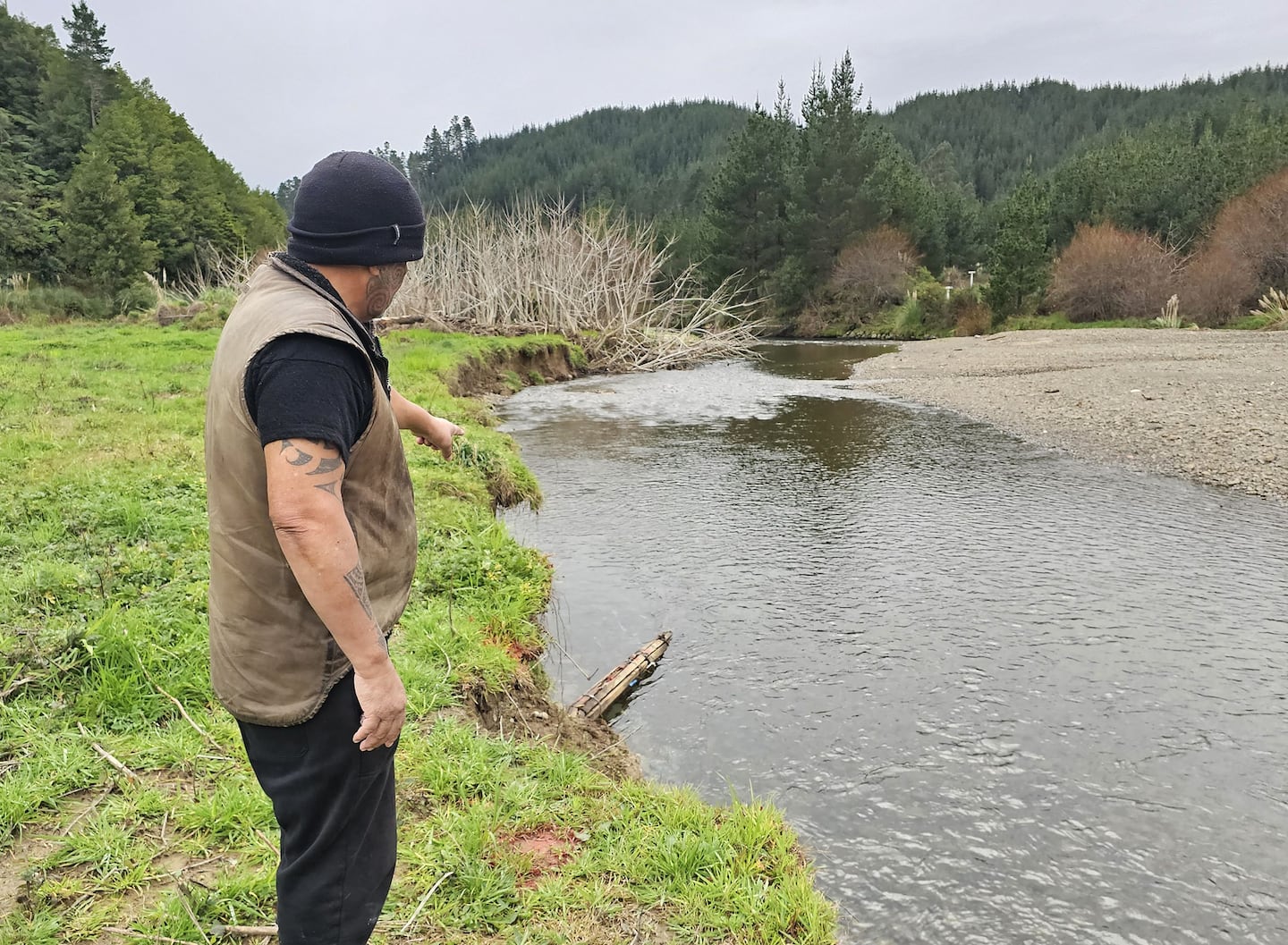
A Waiotahe Valley family have been living in fear of a gas explosion on their property since river movements exposed a high-pressure transmission line.
“It’s an explosion waiting to happen,” said rural property owner Te Kaha.
He was told the blast radius could be at least 500 metres - enough to blow the windows out of his house, on the hillside above. There was also a road within the blast radius.
He has an easement through his property in the Waiotahe Valley, near Ōpotiki in the Bay of Plenty, for the transmission line which takes natural gas from Taranaki to Ōpōtiki and Gisborne.
The gas line is normally buried at a minimum depth of 900mm. Where it crosses under the Waiotahe River, it is buried deeper.
However, changes to the course of the river have eroded the bank and exposed the pipe.
The pipe has been floating loose in the river for months, and now several metres are vulnerable.
Te Kaha fears that a large log or fallen tree swept down the river in heavy rain could put lives in danger.
“If a waterlogged tree hits that pipe, travelling at the force of flood water, that pipe’s history. We had one, 10-14 meters long, just a couple of months ago. It came sideways and stuck on the bridge (upstream of the pipe).”
“They warned me when I first bought the place about 14 years ago that you can’t dig anywhere around here because if you dig and you hit the gas pipe, it is a massive explosion.
“There are only stop valves every 30 kilometres, so that’s 30 km’s worth of high-pressure gas that would be released. The gas is heavy, so it will lie on the ground until something ignites it.”
Te Kaha has been aware of river movements eroding the land around the pipe for some time.
“For about a year and a half now, I’ve been trying to tell the gas company they need to come and have a look because it’s not safe,” he said.
He feels Firstgas, which runs the pipeline, has not taken his concerns seriously or acted quickly enough.

“The say things like, ‘All I can do is convey your concerns to our geotech guys in New Plymouth.”
They had told him they needed to clear any work with Bay of Plenty Regional Council, but he was told by regional council staff that Firstgas had not yet come to them with a plan.
He said he feared not only for his own family but also for others on the road and children who use the swimming hole in the river about 30 metres from the pipe.
“It’s a catastrophe; it’s a train wreck in the making,” he said.
Firstgas operations manager Ryan Phipps said the pipeline remained safe to operate.
“Based on our engineering assessment, there is no immediate safety risk to the public or nearby properties. However, the exposed section does require remediation, which is why we are progressing a long-term solution.”
Since Local Democracy Reporting’s enquiries, Firstgas has met on site with the landowner and regional council and agreed in principle on a practical remediation approach.
The proposed works involved installing protective rock structures upstream of the crossing to reduce the impact of flood flows and debris, encourage sediment to naturally rebuild over the pipeline, and then reinstate additional cover where required.
“The site has been carefully monitored and assessed over time to determine the most appropriate long-term solution.
“The primary constraint is ensuring the work can be carried out safely and effectively. River conditions need to be suitable before contractors can access the site and undertake the remediation.
“We have also been working collaboratively with the regional council and the landowner to agree on the best approach.”
He said if the pipeline were damaged, Firstgas had well-established emergency response procedures to safely isolate the pipeline and respond to the incident.
Bay of Plenty Regional Council rivers and drainage operations manager Dan Batten confirmed that the council had been working with Firstgas toward fixing the issue since April.
“Firstgas manages pipeline crossings in rivers and other areas where erosion, land movement, or changing watercourses can affect pipeline cover. Regional council is aware these locations are routinely monitored and managed through the Firstgas pipeline integrity and geohazard management programmes. In addition to this, regional council understands that Firstgas has well-established emergency response procedures to safely isolate the pipeline and respond to the incident,” he said.
LDR is local body journalism co-funded by RNZ and NZ On Air.