

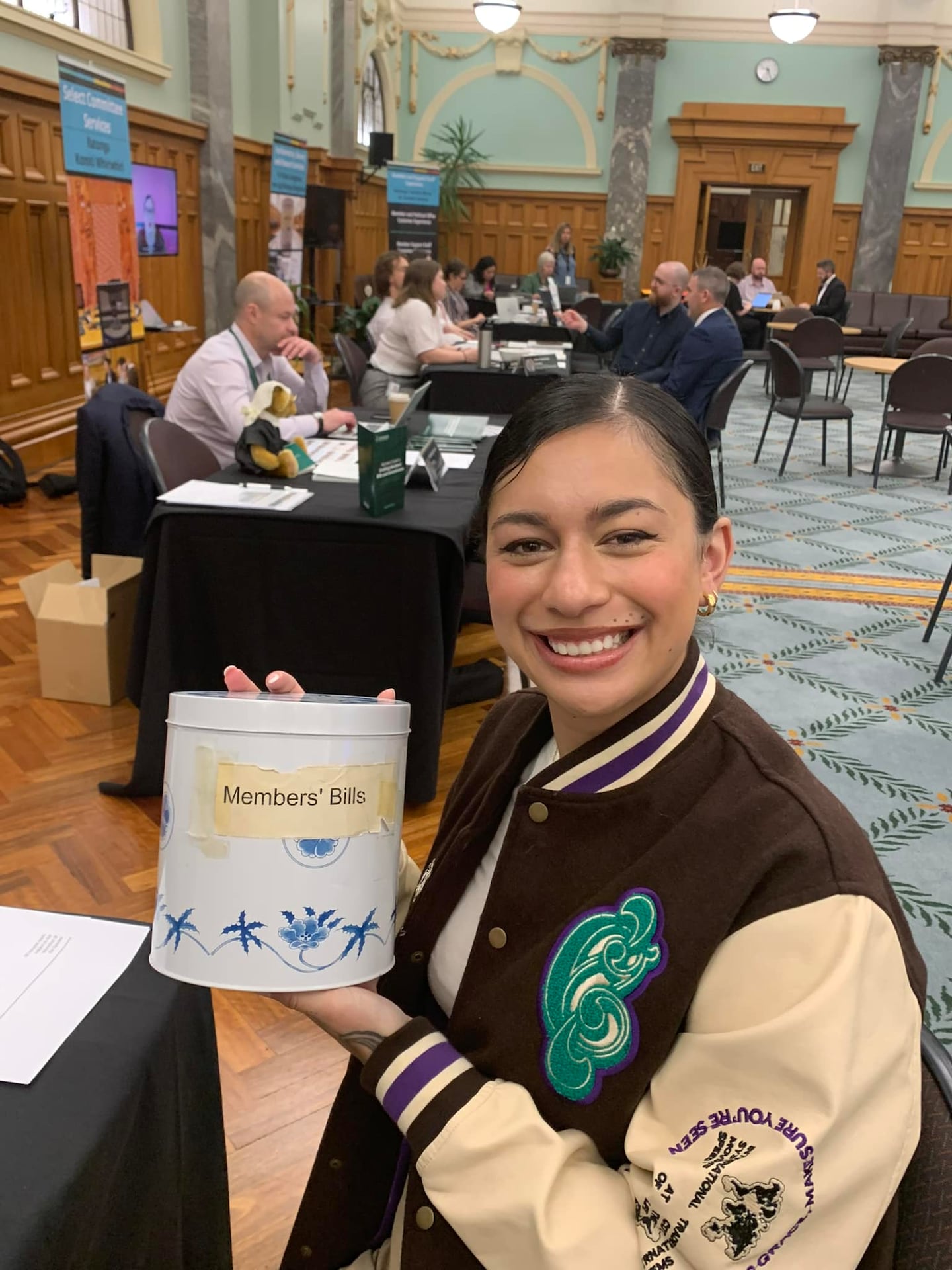
Generation Z is in the House. (Or at least, they will be soon.)
October’s election saw the first wave of Gen Z representatives elected to Parliament, with three candidates aged 26-years or younger.
This generation grew up with the internet but may still have memories of its earliest days (unlike the up-coming Generation Alpha).
It’s an age group which has expressed significant changes in thinking on issues such as the environment, race relations and gender. And it’s a generation which has challenged traditional ways of working, living, and thinking about social issues.
The first three Gen Z MPs have been elected through winning electorates for the Green, National and Māori parties.
They are: Wellington Central MP Tamatha Paul, Bay of Plenty MP Tom Rutherford, and Hauraki-Waikato MP Hana-Rawhiti Maipi-Clarke.

Paul and Rutherford are Gen Z elders, both born in 1997, while Maipi-Clarke was born after the turn of the millennium and is 21-years-old.
Although these three politicians are the first elected Gen Z representatives in Parliament, Gen Zers have filled roles in political offices and taken important positions in political debate for some years.
Infometrics chief executive Brad Olsen, for instance, is a regular visitor to the halls of power, one of the most high-profile economics commentators in Aotearoa, and is a Gen Zer.
Olsen, who was also born in 1997, said he expected some things to change now Gen Z was entering positions of power in Parliament.
“I expect that parliamentary debates will become a little bit more fun and a little bit more direct,” he said.
“Some of the phrases that we Zoomers are known for, we try and cut through the more dense and dull to add a bit of spice to life.”
But Olsen stressed zingers weren’t the only thing Gen Z could bring to Parliament. “I certainly don’t want to make it sound like we’re good for a soundbite, and that’s it,” he said.
But he did believe that having more straight-talking and relatable MPs would be important for boosting public confidence in, and engagement with, Parliament.
“We’ve got a growing younger population, with a different worldview, with different experiences, with different wants and needs and requirements and asks,” he said.
“So having people there who have that experience, who come from a different generation ensures that when it is the people’s house, the House of Representatives, that it is representative.”
While the result of three Gen Z representatives split across three parties showed that the generation’s political opinions spread across party lines, Olsen said he did expect to see some commonalities – especially related to housing.
“We talk a lot about the housing market, but I think we will increasingly hear about the rental market and what Zoomers are facing there,” he said.
Paul, who quit being a city councillor to represent Wellington city in Parliament, said there were some issues around human rights and climate change, which younger generations wanted to stand up for.
“The big thing is climate change. Because at the end of the day, we will live the longest to see the most devastating impacts of climate change,” she said.
She also expected to see younger representatives pushing for greater recognition of Te Tiriti o Waitangi.
“In 17 years, it’s going to be 200 years since Te Tiriti o Waitangi was signed... These are things that we’re going to stand up for because we envisage a future that is informed by Te Tiriti.”
Until speaking to Stuff, Paul hadn’t realised she was amongst the first wave of Gen Z MPs. She asked about Chlöe Swarbrick, who entered Parliament in 2017 at the age of 23.
“Oh is Chlöe a millennial?” Paul asked. Swarbrick is a millennial. Born in 1994, that’s three years before the Gen Z boundary, making her a “young millennial”.
“Yeah, right, so I’m a really old Gen Z,” Paul replied.
She said she didn’t feel much pressure from being a younger MP.
“But I definitely feel more pressure being a young Māori woman, than I do being just a Gen Z. The year you’re born doesn’t necessarily prescribe a whole lot, although it does give a unique perspective on the issues of your time,” she said.

Rutherford, who’s entering Parliament with National, said his age wasn’t that unusual. He pointed to Simeon Brown, another National MP who had started at 26 years old.
He said he’d felt supported joining National, and would ensure younger perspectives were heard in the Government’s caucus room.
“The National Party is a broad church. We are looking to be the political party that is representative of all New Zealanders, and that is both in the diversity sense of ethnicity, diversity of thought and background. And in my case, diversity of age,” he said.
He said there were some issues, mainly housing and climate change, where he thought Gen Z as a whole had a different perspective than older generations.
“I’ve been looking for the last couple of years to purchase my first home. I know the struggle of what it’s like for a lot of people to get together an initial deposit,” he said.
“So when we have those discussions in caucus and at a national level, that’s where I’m going to be able to provide some input from my first-hand personal experience as a 26-year-old.”
At 21-years-old, Te Pāti Māori MP Maipi-Clarke is the youngest parliamentarian Aotearoa has seen since 1853.
Maipi-Clarke said her arrival was the start of the “kōhanga reo generation” taking positions of power.
This new generation, with unapologetic rangatahi “proud to be Māori” and more outspoken, were ready to challenge traditional power, she said.
“I have one job: and that is to tell our story,” Maipi-Clarke said during the Re News youth voters debate.
“I represent the voices, I represent 65% of Māori who are under the age of 35.”
She said respect for Te Tiriti o Waitangi, te reo and tikanga, and rangatahi Māori perspectives on issues such as the cost of living and housing would be her key kaupapa as an MP – and were the main issue impacting her generation.