
Iwi say they’ve been shut out of moves to revamp Taranaki’s local government and should’ve been involved as partners from the start.
New Plymouth District Council (NPDC) and Taranaki Regional Council (TRC) on Thursday presented five possible future council structures for the region, in response to Government reforms.
Papers for a joint council workshop stressed that under the Local Government Act, any future arrangement must include Māori in decision-making.
Implications for iwi, hapū and Māori would “require detailed consideration” as a proposal was finalised for ministerial approval.
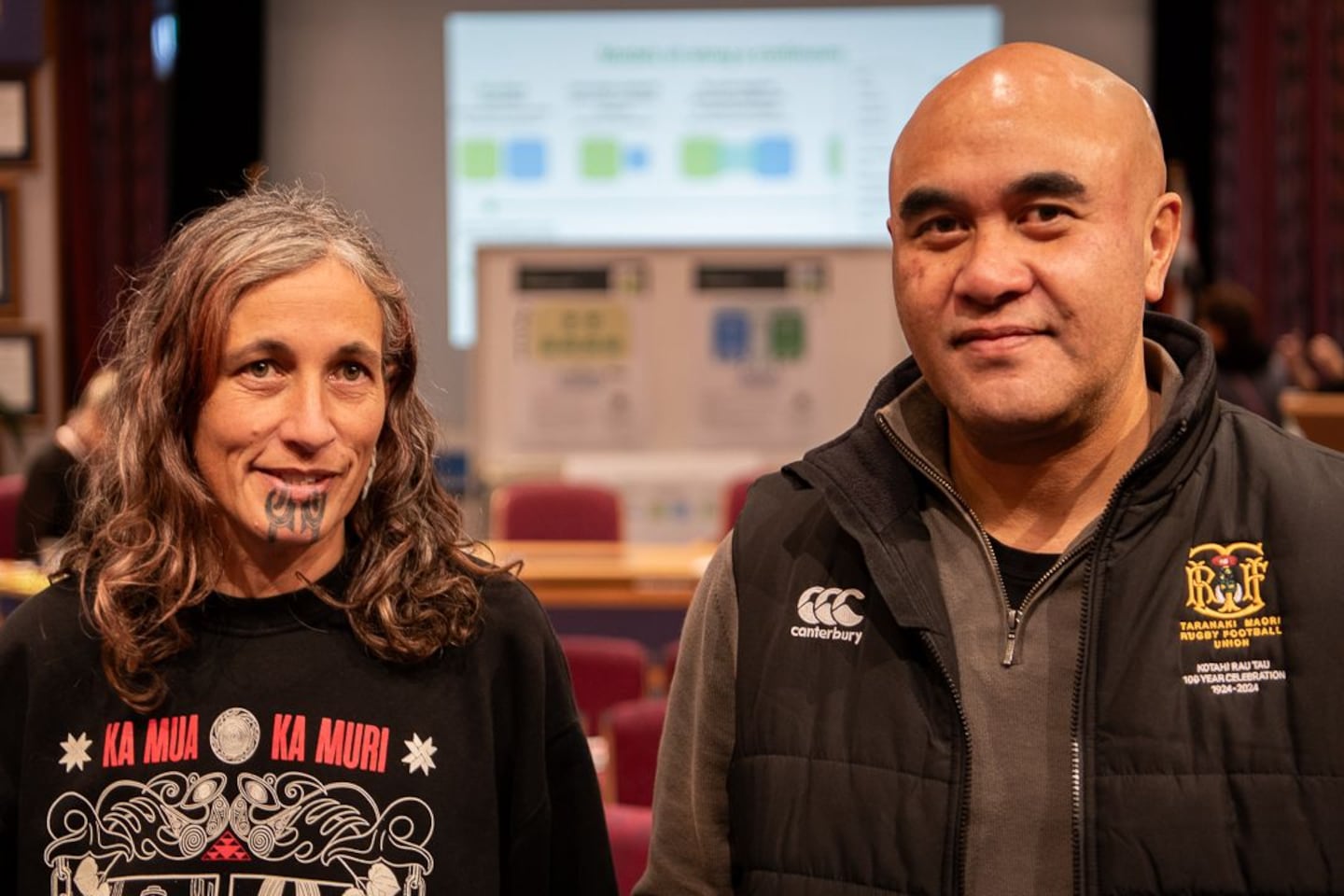
Iwi representatives from TRC’s Policy and Planning committee said that wasn’t good enough.
Mitchell Ritai sits on the committee and is the new pouwhakahaere of Te Kotahitanga o Te Atiawa.
He said Treaty settlements and partnerships would be crucial in choosing a new council structure, but mana whenua hadn’t seen the proposals until the workshop.
“I wouldn’t see us as stakeholders, I’d see us as partners – and as partners it’s not how I would envisage that happening,” Ritai said.
“You would think that we would have been engaged in this a lot earlier.”
Dion Luke represents Aotea waka: “We’re supposed to represent iwi views, but we can’t with this last-minute information.”
“There could be a co-governance model in there somewhere as an option, but that discussion needs to happen in the first place.”
Taranaki iwi’s committee rep Tuhi-Ao Bailey agreed that co-governance ought to be in the mix.
“It should be everyone working together, in partnership with Māori.”
“Instead, Māori are coming later down the line with other stakeholders like the Ratepayers Alliance – it’s just so backwards.”
Bailey, a long-time campaigner for the taiao, said the stakes were “massive”.
“When it comes to environmental management, I don’t know if any of our district councillors have their heads around that.”
The interim joint chief executive of both NPDC and TRC, Steve Ruru, admitted the process wasn’t ideal.
Ruru said normal consultation on the proposals was impossible before the 9 August deadline under the Government’s Head Start process.
NPDC’s general manager of Tiriti partnerships, Bernie O’Donell, said councils were scrambling to meet tight timeframes.
He said there’d previously been no proposals ready for discussion, and nobody yet knew what Taranaki would choose.
“We don’t, honestly, and this is the beginning of that conversation.
“Once we have a form [of proposal] that looks like it could be a working model, then we have to test it with... our Tiriti partners.”
O’Donnell said New Plymouth was lucky to have mana whenua views represented by several elected Māori councillors.
An attempt for Taranaki’s three district councils and TRC to work together on the Government-ordered revamp fell apart at the end of May.
The five new NPDC/TRC proposals range from a single Taranaki unitary authority at one extreme to two independent unitary authorities at the other.
In between are options including two district councils that come together in a joint committee to govern, and possibly deliver, functions at a regional level.
South Taranaki and Stratford councils are working on their own ideas.
New Plymouth Mayor Max Brough said it didn’t mean the region couldn’t unite, and NPDC would be meeting with the southern councils next week.
“Each council is doing its own work, individually.
“We’re not looking to put in a proposal on our own; we’re looking to work together.”
New Plymouth will need a partner – district councils can’t make proposals to Wellington on their own, and regional councils are excluded from the process.
LDR is local body journalism funded by RNZ and NZ on Air.