


Nearly a decade after tents first appeared on the whenua at Ihumātao, the first whānau have moved into newly built papakāinga homes, marking the beginning of a new chapter.
What began as one of the defining Māori land occupations of a generation is now showing what Land Back can look like in practice: returning whānau to their whenua through housing, climate resilience, food sovereignty and cultural revitalisation.

Kylie Tawha called it “papakāinga dreams”.
“This dream started at Tūtiaki Whenua,” said Tawha, using the name adopted for the occupation, meaning to stand and care for the whenua.
Just two months before moving in, Kylie had a heart-to-heart kōrero with her cousin Pania Newton. Soon afterwards, Newton offered her whānau one of the papakāinga homes.
“She is a doer, Cousin Pans; she doesn’t talk shit – she’s mahi hard. If she says she’s going to do something, she does it, and she does it at full force – no half pai with her,” Tawha said.
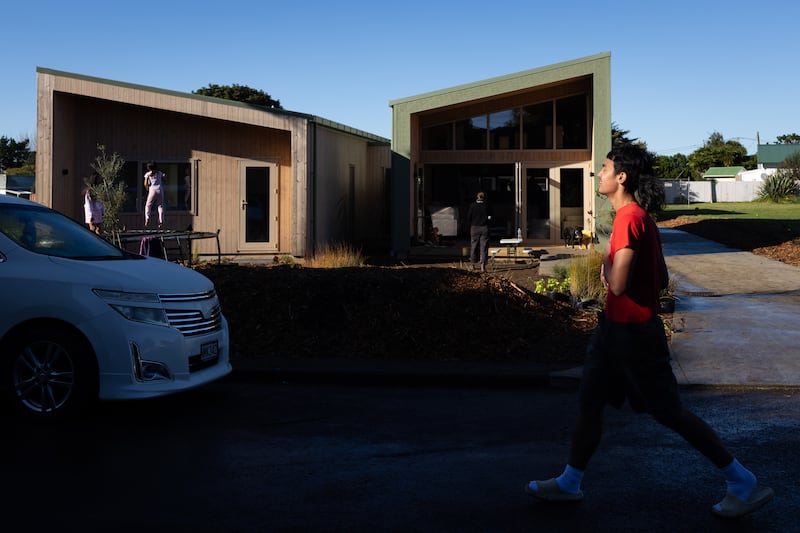
Tawha, her tāne and their four children have settled into a four-bedroom home on the whenua where she grew up. Their children now wake each morning surrounded by cousins, aunties, uncles and pākeke on their tūrangawaewae.

Two years ago, Leilani Tawha was raising her young family in a damp, mould-ridden house. Her baby developed severe eczema that repeatedly became infected.
“I was at mahi one day, and I spoke with Pans,” she said, wiping away tears.
“I told her how sick my baby was, how we had to move, and we just couldn’t do it anymore.”
After leaving their mouldy rental, the family spent more than a year moving between relatives, living together in a one-room cabin.
“It was crazy. We were a family of five living in a cabin that was basically one long room, no kitchen or bathroom,” she explained.

Leilani Tawha’s story reflects a reality experienced by many Māori. Tangata whenua — people of the land — continue to face disproportionate housing deprivation. The 2023 Census estimated 34,557 Māori were living in severe housing deprivation, while a further 23.3 percent lived in overcrowded households. Research has also found housing insecurity can leave wāhine Māori trapped in abusive relationships because they have few safe and affordable housing alternatives.

Soon after their conversation, Pania Newton offered Leilani’s whānau one of the papakāinga homes. For Leilani Tawha, it meant far more than a new house.
“It meant our girls weren’t going to be sick anymore, and we could come back home to our papakāinga.”
Her two-year-old now runs and rolls around their new home, while their eldest catches the school bus with her cousins. Morning sun streams through the house, keeping the rooms warm throughout the day.
“It’s been like a dream,” she said. “We still can’t believe it. Things like this don’t usually happen to people like us.”

While on maternity leave, Leilani is looking forward to returning to her role with Te Ahiwaru’s ecotourism team, where she helps visitors understand how centuries of history have shaped Ihumātao. She noted that much of the city’s infrastructure that Aucklanders use today was built at the expense of her people and their ancestral landscape. This includes land taken for the airport, structures built across the moana which disrupted waterways and food sources, rivers cut off from the sea, and volcanic maunga quarried to build the city roads.

“I don’t know how to word it properly, but there’s just been a lot of mamae that’s happened to our whenua and our whānau,” said Tawha.
“Oppression,” replied her Aunty Donna.
Donna Tawha’s son is also preparing to move onto the whenua, into a two-storey home still under construction behind the first papakāinga.
Holding Leilani’s two-month-old pēpi, she reflected on the generations who never lived to see this day, including her brothers and the fathers of Leilani and Kylie.

“These visions and opportunities were too hard for us to see because of everything my mother and father’s generation went through,” she said. “Everything has finally come to light, and great things are coming our way.”
She said the struggle had always been about the mokopuna’s mokopuna. As she finished speaking, Pania Newton arrived in gumboots to finish planting the native landscaping around the whare.

Decades of struggle, centuries of history
This year marks 10 years since the occupation began, but Pania Newton said the movement was only continuing the work of generations who had stood for the whenua before them.
Since at least the 14th century, Te Ahiwaru tūpuna lived at Ihumātao, developing one of Aotearoa’s oldest stonefield gardening systems and sustaining a thriving pā. That way of life was shattered in 1863 when Governor George Grey issued a proclamation requiring Māori living between Auckland and the Waikato to swear allegiance to the Crown or withdraw south of the Mangatāwhiri Stream, paving the way for the invasion of Waikato.
During the invasion, the whenua at Ihumātao was confiscated under the New Zealand Settlements Act. In 1867, the Crown granted the land to the Wallace family. Some descendants of the original ahi kā remained nearby, later working as domestic servants and labourers on their ancestral whenua.

When Fletcher Building purchased the Wallace Block from the family for housing in 2016, many uri of Te Ahiwaru saw history repeating itself. Opposition galvanised under Save Our Unique Landscape (SOUL), founded by Pania Newton, her cousins and whānau. The occupation that followed became one of the defining Māori land movements of a generation.

The campaign extended well beyond Kaitiaki Village, the frontline occupation site at Ihumātao. It moved through the Environment Court, into Parliament through petitions and political advocacy, and onto the international stage through engagement with United Nations mechanisms on Indigenous rights.
A parallel legal and political strategy challenged the proposed Fletcher development at every stage.

By 2019, Ihumātao had become a national flashpoint. Police moved to evict protectors from the whenua, prompting thousands of supporters to converge on the site.
Kīngi Tūheitia visited Ihumātao, meeting with mana whenua and supporters while calling for a negotiated resolution grounded in the return or recognition of the whenua. The dispute drew international attention before the Crown purchased the land from Fletcher Residential in 2020, bringing the conflict to an end.
Building a resilient future
Following the return of the whenua, a rōpū whakahaere was established to work alongside whānau in guiding decisions about its future.

Te Ahiwaru Trust held more than sixty wānanga, where housing emerged as one of the community’s highest priorities.
Newton and her tāne purchased the whenua in 2020 to bring it back into the hands of their whānau. At the time, she had no job and was still working through what land reclamation would mean in practice, while navigating her own pathway into home ownership.
Turning that vision into reality took another five years. COVID-19 delayed funding and construction, while papakāinga funding remained uncertain.
“It took a lot of vision, courage and tenacity to get where we are today,” she said.
Newton describes the first homes as a pilot she hopes will enable many more Te Ahiwaru whānau to return to healthy, affordable homes connected to their identity. She said the challenges of delivering the project have strengthened the trust’s capacity and capability, with lessons they now plan to carry into future papakāinga developments.

The idea gained momentum during the COVID-19 pandemic, when many whānau experienced anxiety around food security and the importance of becoming more self-sufficient became clear.
“We planted the subtropical food forest late last year, and we’re already enjoying the fruits from it. We’ve just planted the temperate food forest alongside our avocado orchard,” Newton said.
The food forest sits alongside a community māra where whānau can harvest kai for their homes or marae kaupapa.

Climate resilience shaped the papakāinga itself. Following Auckland’s anniversary floods in 2023, the homes were designed with flood risk in mind, while native planting will increase canopy cover across the papakāinga. The marae is already largely powered by solar energy, with plans to expand generation and eventually reduce power costs for whānau.
“It’s not just about kai,” Newton said. “It’s about reconnecting our whānau to our whenua and creating an ecosystem of kaupapa that allows us to exercise our kaitiakitanga, mana motuhake and rangatiratanga.”
Restoring the arts and culture
As more whānau return to Ihumātao, they are also shaping the future of the whenua; carver and taonga pūoro practitioner Jadyn Flavell is one of them.

After his late koro passed away, Flavell’s uncles asked him to continue his whakairo mahi. The invitation drew him deeper into te ao Māori and the world of whakairo, beginning a journey that eventually led him back to Ihumātao.
Staying in the old farmhouse, he hopes to transform the space into a permanent mahi toi hub. Plans include wānanga in whakairo and taonga pūoro, with another practitioner preparing to join him to establish a dedicated pounamu workspace.
“Knowing the history here, and through the protests, Ihumātao has a certain āhua to it, an energy that helps facilitate that kind of space,” Flavell said.

This story was produced in collaboration with photojournalist Ryan N. Comfort, an Assistant Professor of Journalism at Indiana University. He is a citizen of the Keweenaw Bay Band of Lake Superior Ojibwe in the United States, and his work focuses on Indigenous science and environmental issues.