

An ancient Māori war cloak has been formally welcomed back to Auckland Museum, sparking emotional scenes among researchers, curators, and expert weavers who say the taonga’s return marks a significant moment in cultural heritage care.
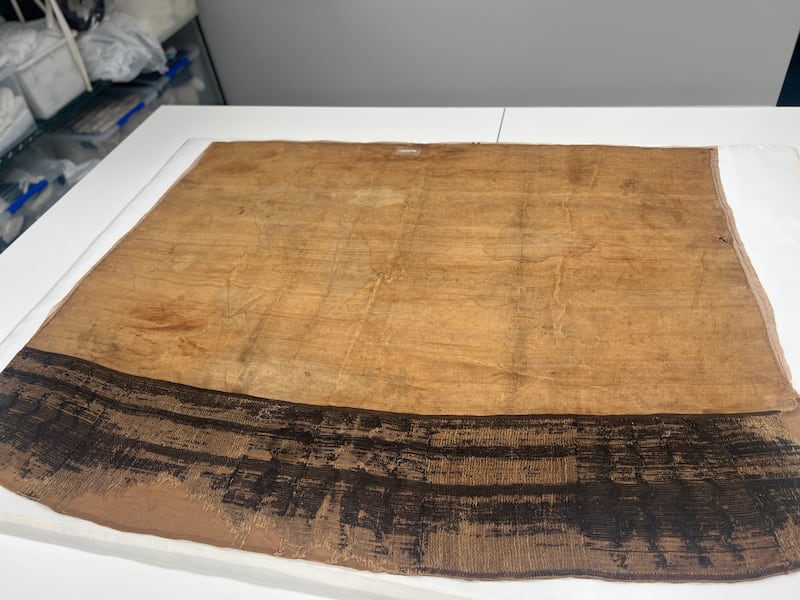
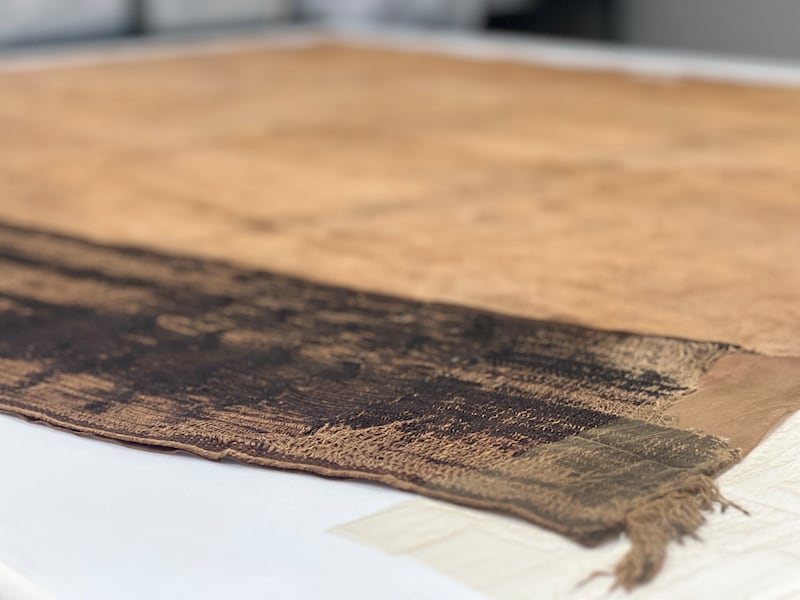
The cloak, known as a pauku, is one of only five such garments known to exist. Woven with tight rows of whatu patahi (single-pair weft twining), the pauku was traditionally designed as a form of battle protection, strengthened through water, mud, or other substances to harden its structure.
The pauku had been held in storage at Durham University’s Oriental Museum in England for many decades. Its reappearance and the opportunity for Māori weavers to handle and examine the taonga brought overwhelming emotion to those present.

What is a Pauku?
Expert weaver Kahutoi Te Kanawa, daughter of famed tohunga raranga Diggeress Te Kanawa, says the pauku was specifically created for close-quarters fighting.
“Ko te ingoa o te pauku, te pukupuku rānei, ko te tiaki i te puku, hei tiaki i te toa. He kahu whawhai, nō te pakanga i mau i te toa.”
A pauku could be held against the torso or arm during combat, its dense weave absorbing strikes. Te Kanawa says the cloak’s rediscovery has deepened her understanding of ancestral knowledge.
“I te tau 2017, i kitea e tōku tuakana, e Rangi i haere ki Ingārangi, ki Durham, te whare taonga, ahau hoki. He tirohanga, he whakaaro, i kite au i te pauku nei, he piki ake ki ngā mātauranga o ngā tūpuna,” she says.
A Cloak Designed for Battle
The pauku’s structure distinguishes it from other cloaks. Its thickness results from the tightly woven whatu patahi, and the practice of soaking the garment in water, mud, or other materials to toughen it.
“He kahu pakanga te pauku, e tiaki nei i te toa mā tōna puku, mā tōna ringaringa rānei, i a ia e whawhai tata ana i tētahi atu. Ka mutu, ko te pauku, he kahu i toromi ki te wai, ki te paru, ki te aha atu rānei kia tānekaha ake ai tōna hanga, e tiaki pai ai te toa.”
Durham Oriental Museum curator Rachel Barclay says the pauku reflects a highly developed understanding of textile technology.
“We had a researcher last week when we were still in Durham, and saying, yeah, textiles are such a good method of protecting yourself because they give. Armour, you know, solid armour when something hits it, it’s like. Whereas if you have a textile and it hits, it gives, it moves. So, it’s actually really sensible.”
She describes the pauku as an unparalleled achievement in Māori material culture.
“It’s an extraordinary creation, unmatched by anything from another culture.”
Emotional Discovery in Durham
Although the pauku had been in Durham’s collections since the 1960s, Barclay says it had sat largely unnoticed in storage until recent years, when Māori experts visited the museum and identified its significance.
“We all ended up in tears, it was a really emotional afternoon, because learning, I learnt so much just that day from the ladies as they were talking about it and they were exploring it, getting excited.”
Seeing Māori experts engage directly with the taonga was a turning point for the museum.
“Just really amazed and overwhelmed that we had something this incredible in the collection. And then, just so many questions about what does that mean, how do we care for it, how do we make sure that we treat it respectfully,” she says.
Tracing the Pauku’s Journey
The exact origin and maker of the Auckland pauku remain unknown, but it has been traced back to the 18th century. Records show the cloak was loaned to Durham University Museum in the mid-1960s before being officially gifted in 1971.
Because the pauku spent decades stored away, many at the museum were unaware of its existence or cultural value.
That changed when members of the Te Kanawa whānau and other Māori researchers visited Durham, sparking a process of renewed engagement and, ultimately, the cloak’s return to Aotearoa.
Barkley says the experience transformed her understanding of Māori taonga and the responsibilities of international museums.
“Upon learning the origin of the pauku, we realised how important it was to understand not only what it is, but how to honour it, care for it, and recognise its significance to Māori.”
Precious taonga returns
The pauku is now housed in the Auckland Museum, where its conservation and presentation have been prioritised.
Its return is part of a wider movement among museums to confront the histories of how Indigenous objects came into overseas collections, and to work collaboratively with source communities to ensure cultural safety and appropriate custodianship.