

Te Matatini has become so successful and so big that it’s starting to forget who it is for.
That’s not a criticism of kapa haka, but a warning about what happens when success surpasses the systems meant to protect the kaupapa. In 2025, Te Matatini reached record audiences, record visibility and delivered a massive economic boost to Ngāmotu.
Year on year, it grows and sets new records of reach and economic return to the rohe. And yet, thousands of whānau who made the journey to Ngāmotu this year couldn’t see the stage. That alone should stop us in our tracks.
If you travel across the country to attend the pinnacle of Māori performing arts and end up watching from a screen behind the VIP area and judges’ tent, something is broken.
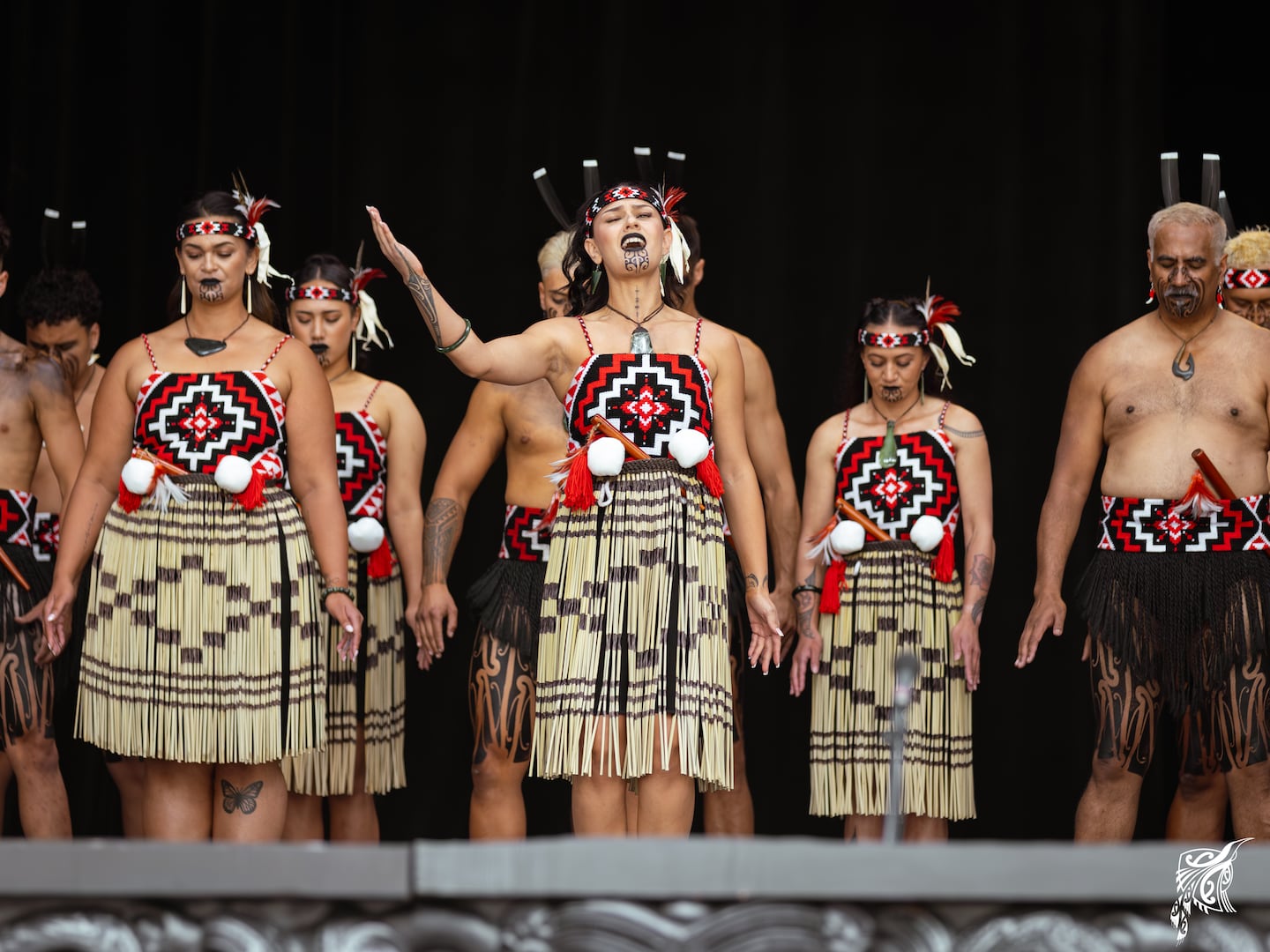
This isn’t just a concert or sport. Kapa haka relies on the presence of people as a collective who come to feel the ihi, wehi and wana. It’s a physical expression and exchange between the kapa and the audience.
When people are physically there but effectively locked out, we need to ask hard questions.
Growing pains
I know firsthand what that connection feels like as a performer, audience member and broadcaster. I know how much a performer feeds off the audience, the expressions, the reactions, the silence, the noise.
That exchange is not incidental; it’s part of the performance. When the audience is pushed further away or fractured, something is lost for both sides.

What Te Matatini is now expected to deliver has shifted. It is no longer just about the highest calibre of kapa haka excellence; it is also about broadcast numbers, crowd management, sponsorship, global reach and economic impact.
None of those things is inherently bad. But when they start dictating how the festival is designed, who gets access and how, and where it can be hosted, the kaupapa begins to curve.
Kua tipu, kua rea
The move to shift Te Matatini 2027 from Te Tau Ihu to Waikato has only amplified that tension. The implication, whether intended or not, is that only certain regions are now “big enough” to host Te Matatini.
Big enough infrastructure. Big enough budgets. Big enough systems. That might make sense on paper, but it sits uncomfortably alongside ideas of regional equity and tino rangatiratanga.
And yet, growth has also mattered.

For the broadcast station I work for, Te Matatini’s expansion has been powerful. Broadcast and digital coverage have allowed us to reach kaumātua who can no longer travel, whānau overseas, and people who have never stood on a Te Matatini field in their lives.
This was the second Te Matatini broadcast I’ve been involved in, and the responsibility that comes with that is heavy. The job is not just to capture a performance in words, it is to try to make people feel what I feel, hear what I hear, and see what I see when a rōpū takes the stage.
Livestreaming, when done right, is not a downgrade. It is a form of access. But it should never become an excuse. Digital reach should extend Te Matatini, not justify excluding those who have turned up in person who have paid oodles of pennies to push their way into the space.
The issue isn’t that Te Matatini has grown. It’s that growth has been allowed to redefine success. Bigger crowds. Bigger numbers. Bigger headlines. If those become the primary markers, then audience access, tikanga and manaakitanga become negotiable, and they shouldn’t be.
Te Matatini needs to be braver. That might mean capping regional qualifiers, implementing multiple stages, or making structural changes. What it cannot afford is to keep growing on autopilot.
Because when your whānau are present but excluded, and the kaupapa becomes secondary to logistics, size stops being a strength, it becomes the problem.
