

This article was first published on RNZ.
For more than three decades, Aotearoa’s longest surviving independent Māori theatre company has used storytelling to open kōrero about trauma, healing and hope in communities across the motu.
Te Rākau Hua o Te Wao Tapu (Te Rākau) was established in 1989 as a space for Māori performance activists to be “in control of telling their own stories”.
Since then, the company has taken theatre beyond traditional stages and into marae, community halls, prisons and youth residences.
Te Rākau co-founder and current director Jim Moriarty (Ngāti Toa Rangatira, Ngāti Kōata, Ngāti Kahungunu, Rangitāne) said they had been committed to telling their people’s stories “in a way that opens pathways to wellness”.
“I don’t think we’re doing anything new - we’re doing it our way,” Moriarty told RNZ.
“We wrap our work in the rituals I grew up with, manaakitanga, whanaungatanga, whakapapa, caring for people.”
In its early days, Moriarty said Māori were not coming to mainstream theatre.
“So we decided to take theatre to our people… wherever our people are.”

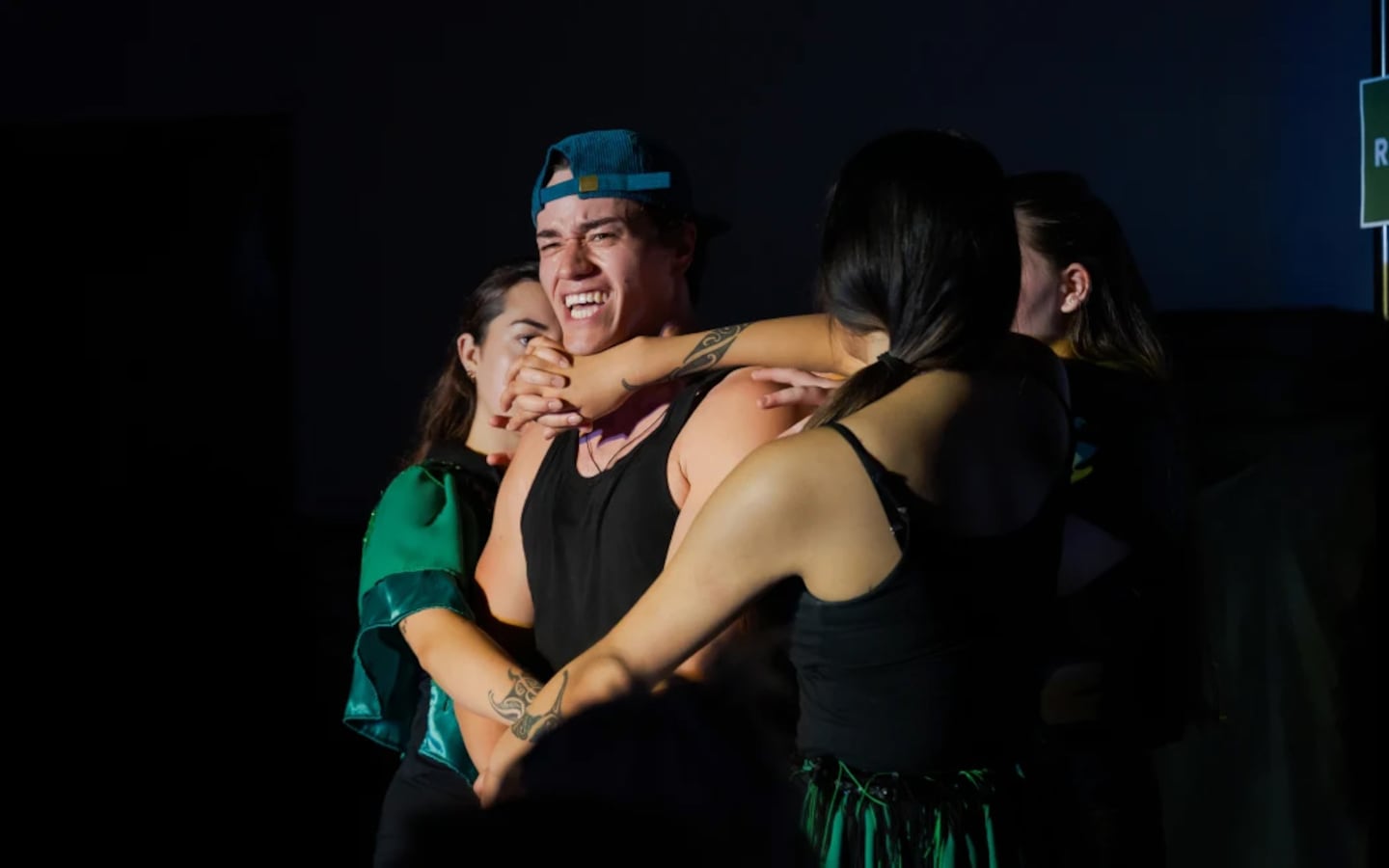
There most recent productionOut the Gateexplores the pipeline that leads many Māori from childhood trauma into state care, youth justice, and ultimately incarceration.
“At its heart, the work is about the wounded child,” he said.
“About accountability, and about hope. With the right support, people want to walk into the light.”
Unlike conventional theatre, Out the Gate did not begin with a script, he said. It began with research grounded in whānau experience.
“About 80 to 90 percent of what people saw was verbatim.”
The production drew on the Kaupapa Māori research project TIAKI - Community wellbeing for whānau with [https://www.rnz.co.nz/news/te-manu-korihi/580726/kaupapa-maori-study-exposes-gaps-in-prison-data-and-support-for-maori
lived experience of incarceration], funded by the Health Research Council.
Central to that work was kōrero with nearly 50 whānau with lived experience.
"Out the Gate traces the journey from childhood into state care, youth justice, and prison," Moriarty said.
“The research programme ran for three years. Four of the researchers were whānau apprenticed with me, people who had lived experience and could extract deeper kōrero.”
Moriarty’s partner of 28 years, Helen Pearse-Otene (Ngāpuhi, Taranaki), a writer, psychologist and Toi Whakaari graduate, played a key role in shaping the material, he said.
“Helen synthesised all of that - she’s incredibly rigourous as a researcher.
“We combined it with our own lived experience, fostering hundreds of young people over the years.”
Their work, Moriarty said, was inseparable from tikanga Māori and the healing frameworks embedded within te ao Māori.
“When people start forming new relationships with unresolved trauma from childhood, a space opens up, because that work happens on the marae, tikanga and Māori identity flow naturally into that healing.”
The way Te Rākau works, he said, mirrors the way tūpuna engaged with the world, “collectively and with care”.
“That whole way our tūpuna expressed themselves through whole-of-life engagement. That’s how I create and run theatre,” he said.
“From the very beginning, and even after the journey’s over, it’s about taking care of people.”

That approach extends beyond the performance itself, he said. After each performance of Out the Gate, the cast and crew held open kōrero with audiences.
“After each show, we held kōrero with the audience - judges, whānau, people recently released from prison, probation officers, social workers,” Moriarty said.
“Often those kōrero lasted longer than the show.”
Those conversations, he said, are where much of the healing happens.
“It’s about landing in a place where we can be practical, creative, and reinforce the joy of being Māori. And that’s never been more important.
“I don’t think I’ve ever seen such an open attempt to invisibilise Te Tiriti, to homogenise us, and to undermine our core values and relationship with tino rangatiratanga.”
Moriarty and Pearse-Otene worked as cultural supervisors for Corrections for about a decade, and Moriarty also helped facilitate creative Māori-based programmes in prisons around the country.
“Imprisonment has always been a subject close to me,” he said.
“I’ve had whānau in and out of the whare herehere. Imprisonment has been part of our history - rightly or wrongly - and it doesn’t look like it’s going away.
“If you look at history, Taranaki, Parihaka, imprisonment isn’t new for our people.”
He believes incarceration cannot be understood without recognising the trauma that sits beneath it.
“Underneath incarceration is trauma,” he said.
“This work didn’t come out of nowhere - it’s been in my bones all my life. I grew up around discussions of fairness, equity, and institutionalisation.”

Moriarty was born and raised on the marae in Porirua, so his upbringing immersed him in tikanga Māori from an early age - whaikōrero, waiata, haka, manaakitanga and the responsibility of hosting manuhiri.
He said his early life as a “pā kid” shaped both his worldview and his creative practice.
“The old people would watch you running around and decide where you might fit... fishing boats, singing and dancing, shepherding,” he said.
“That’s how they nurtured us.”
Those foundations later shaped both his theatre practice and his training as a psychiatric nurse, bringing together storytelling and mental health in ways that continue to inform his mahi with Te Rākau today.
“Theatre has always been a great love of mine,” he said.
“I come from a generation where we had an old valve radio in the house. That’s how the world came into our home. When it went all staticky, you’d give it a slap. So we told stories. Whoever could tell the spookiest story got the apple.”
He said these experiences underpinned his mahi today.
“That whole way our tūpuna expressed themselves through whole-of-life engagement. That’s how I create and run theatre,” he said.
“From the very beginning, and even after the journey’s over, it’s about taking care of people.”

While Out the Gate has finished its initial run, Moriarty hopes the production will tour again, particularly into prisons, if funding becomes available.
In the meantime, Te Rākau is currently developing its next production, Don’t Vote, Don’t Moan, But Register, encouraging Māori participation in the electoral process.
“It’s not about voting left or right,” Moriarty said.
“It’s about voting informed, voting with heart. If we want to be at the table, we need to vote.”
But Moriarty said whether on stage, in a prison, or on a marae, the purpose is to create spaces where people feel safe to speak, to listen and to begin healing together.
“With the right support,” he said, “people want to walk into the light.”
By Layla Bailey-McDowell of RNZ.