


Hapū of Taranaki iwi want their interests along the region’s western coast officially recognised, so they can continue to protect kaimoana when the current rāhui is no longer legally enforceable.
A hui at Puniho Pā this week agreed in principle that hapū would apply together for recognition of a collective rohe moana along the entire coastline from New Plymouth to Ōpunakē.
The proposal to apply is now with each hapū to endorse, or not.
A recognised rohe moana is a coastal or marine area where mana moana and customary interests are legally recorded and protected.
Only tangata whenua can make submissions on a rohe moana application but community meetings will take place in the second half of March to update the wider public.
At the end of 2022 the government gave legal backing to a rāhui – a customary prohibition – along 70 kilometres of the Taranaki coast, banning collection of shellfish under fisheries law.
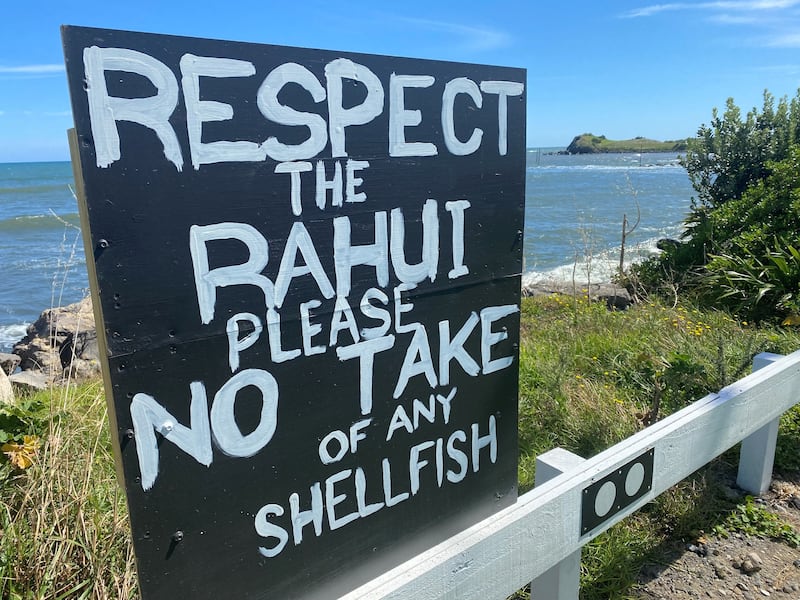
The legal ban was renewed two years later, but it expires in December and rāhui coordinators believe another extension unlikely.
A collective rohe moana is a step towards each hapū being able to place legal protections on particular zones in its own territory.
A rohe moana is a tool to manage the area, not a property claim – the coast remains un-owned.
Once a rohe moana is established mātaitai reserves can be set up to protect certain reefs, spawning grounds and the like.
Mātaitai reserves are specific areas of coast, ocean and even rivers legally regulated under tikanga by mana whenua – in this case by each of the hapū of Taranaki iwi.
Mātaitai are closed to commercial fishing and allow mana whenua to set bylaws affecting recreational and customary fishing.
Te Kāhui o Taranaki chair Jacqui King said after talking with oceans and fisheries minister Shane Jones she didn’t think he would support another extension of the current ban.
“But his recommendation was hurry up … His recommendation was absolutely mātaitai reserves,” King told the hui.
She said a rohe moana application would be based on research completed for Taranaki iwi’s Treaty settlement and its bid for Marine and Coastal Area recognition.
Te Kāhui o Taranaki kairukuruku tūhononga taiao Ngahina Capper said the decline of kaimoana from over-harvesting was well documented along the entire coastline.
The taiao engagement coordinator said three undisclosed reefs had been monitored under the rāhui and there was a healthy bounce-back on two of them – with a third affected by sand inundation.

“Although it is recovering more time is required,” Capper said.
“Yes, it’s recovering, but it doesn’t mean open the gates or you’ll go back to square one.”
Currently Taranaki regulations prohibit taking of pāua under 85mm but Capper said there’d been much talk about leaving the biggest ones on the reefs.
“You hear kōrero about tūpuna not actually taking the big ones, because they’re the breeders, but instead taking the middle-sized ones.”
Seasonal restrictions guided by local knowledge would also be possible.
Parihaka kaumātua and former government minister Mahara Okeroa said the issue was critical.

“It’s about sustainability and the obligation that we have to preserve our tāmōmō o Tangaroa [dwindling sealife],” Okeroa said.
“I’m talking about not for us, but for the coming generations.
“It’s just not about pāua, it’s about the whole collection of species that are interdependent, in order to keep the ecological balance.”
Orimupiko was the first hapū to declare a rāhui on taking kaimoana from their rohe around Ōpunakē in December 2021.
The rāhui spread hapū by hapū along the coast until all of Taranaki iwi’s territory was under the ban.
Hapū and iwi said they had to act as busloads of visitors from Auckland’s Asian communities travelled to Taranaki to collect seafood on organised weekend tours.
The scraping of rocks by visitors came on top of kaimoana gathering by locals who also had often been heedless of environmental or legal limits.
Even before government backing the rāhui gained support from local fishers, divers and boaties.
The rohe moana proposal will be presented during March in community hui at Ōkato Domain (16th), Ōāonui Hall (18th), Cape Egmont Boat Club (22nd), Ōpunakē Events Centre (23rd), Kaitake Community Hub (25th) before another collective marae-pā-hapū hui at Ōākura Pā on March 29.
The ban under section 186A of the Fisheries Act covers all species of shellfish, anemones, conger eels and seaweed (except beach cast).
It extends two nautical miles offshore, covering some 300 square kilometres, with fines of up to $5000, or up to $100,000 if kaimoana is taken for sale.
LDR is local body journalism funded by RNZ and NZ on Air