


I whakaputahia tuatahitia tēnei ātikara e APTN News i Kanata
The Native Women’s Shelter in Montreal (NWSM) is getting set to host a week of mock tribunal hearings to raise awareness of the federal government’s role in residential schools and unmarked graves.
The hearings will be hosted by a group called the Permanent Peoples Tribunal, or PPT, which holds events around the world that seek justice for human rights violations.
“We have over 2,000 pieces of evidence to prove it,” says Na’kuset, executive director of the NWSM, referring to the Canadian government’s role in the Residential school system. This evidence will not be released until the tribunal begins later this month.
For Na’kuset, the tribunal seeks further accountability from the federal government. More than ten years after the Truth and Reconciliation Committee’s final report, many calls to action are yet to be implemented. Crown-Indigenous Relations and Northern Affairs Canada says more than 85 per cent of the 76 calls involving the federal government are completed or in process to be completed.
Indigenous Watchdog, which monitors reconciliation and the implementation of these calls, disagrees. According to the organisation, only 10 of these calls have been completely implemented as of April 1, 2026.
The tribunal will be held for five days, from May 25 to 29, inviting people from inside and outside Canada to serve as judges to oversee the evidence and deliberate on a judgment. Any decision the tribunal makes is not legally binding on the government.
According to the PPT website, it “receives a request from movements, associations, individuals and communities” to hold hearings around the world.
In April, the government was notified of the upcoming PPT. Na’kuset says there has been no response.
“I don’t know how the Canadian government has gotten away with all the damage they’ve done, but we are living it,” she says.
While overlooking her documents, Na’kuset shares the various human rights violations the PPT has categorised. “We fall into, most easily, crimes of genocide and crimes against humanity,” she says.
PPT General Secretary Gianni Tognoni says the tribunal was established to give visibility and voice to the victims of repression. While the judgments only provide a recommendation to the government, Tognoni says it can lead to greater change.
He cites the verdict of the first PPT held in 1979, addressing the violation of the right to self-determination and independence of the Sahrawi people by Morocco and Mauritania.
“At that time, the Western Sahara people were practically non-existent as a subject of law, because they were considered to be really Bedouins, people of the desert,” says Tognoni. “The verdict of the tribunal was the first document for them to be identified as a people.”
He says this judgment led to greater change.
“With that document, they were then later recognised by the African courts and the African Union,” he says.
Ellen Gabriel will be one of them.
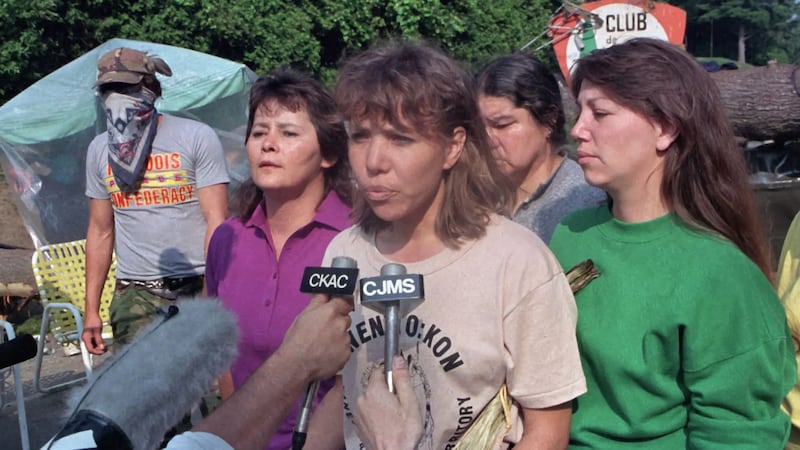
In 1990, Gabriel was chosen by the people of the Longhouse to be spokesperson during the Canadian army’s 78-day siege of Kanehsatà:ke.
What happened in 1990 “is part of that land theft, that part of dehumanising Indigenous peoples so that they can justify the violence and the brutality when they take our lands,” says Gabriel.
For Gabriel, the tribunal still carries weight despite the PPT’s judgment not being legally binding.
“If [Canada] totally rejects the recommendations of the tribunal, then it goes to prove what Indigenous people have been saying all along, that Canada just placates its public. Canada is just a performative actor of human rights,” she says.
Na’kuset hopes the PPT will put the issue of unmarked burial sites back at the forefront of conversation in Canada.
“I don’t like the fact that the mass graves are not in the education system,” she says. “I want it in the history books– I love the idea of having a museum in every province.”
The PPT will be held at the Daphne Art Centre in Montreal.
Nā Savanna Craig nō APTN