


Just one week after the release of New Zealand’s national climate risk assessment, the Government moved to change climate law - announcing plans to shield companies from being sued in civil court over harm linked to greenhouse gas emissions.
Days before the proposal was unveiled, Te Ao Māori News spoke with climate advocate Mike Smith, the man taking six of the country’s largest emitters, including Fonterra, to the High Court next year.

In a follow-up interview after the announcement, Smith said the Government’s move to limit climate-related court action reinforced his view that the state was acting in the interests of major emitters rather than affected communities.
Before the announcement
Before the Government’s announcement, Smith said he hoped the case would become a breakthrough moment for climate litigation and establish legal precedents that communities in other countries could also draw on.
After reading the national climate risk assessment, he said the report showed government action was still falling far short of the speed and scale needed to protect communities from worsening climate impacts.

He pointed to a series of extreme weather events in recent months as evidence that the climate crisis was already being felt across communities, with Māori among those most vulnerable to the impacts.
Smith argued major emitters should be held accountable for their contribution to climate harm, and said the response required urgent action and proper resourcing for Māori-led responses in affected communities.
“The government’s not doing enough to get on top of the problem, so we’re going directly to the source of the pollution, and we’re asking the courts to compel them to act,” Smith said.
“The government has the power to regulate the activities of these big companies, to make sure they’re not causing any more harm. They can do that, but they’re not.”
Government moves to block claims
On May 12, the Government announced plans to amend climate legislation to prevent companies from being sued in civil court for harm linked to greenhouse gas emissions.
The proposal would block tort-based climate litigation, including ongoing and future cases, and would apply retrospectively.
Smith described the move as “deeply concerning”, saying changing laws while a case was still active risked undermining confidence in the independence and fairness of the courts.
He compared the situation to the Foreshore and Seabed controversy, where Māori legal avenues were altered while rights claims were being pursued.
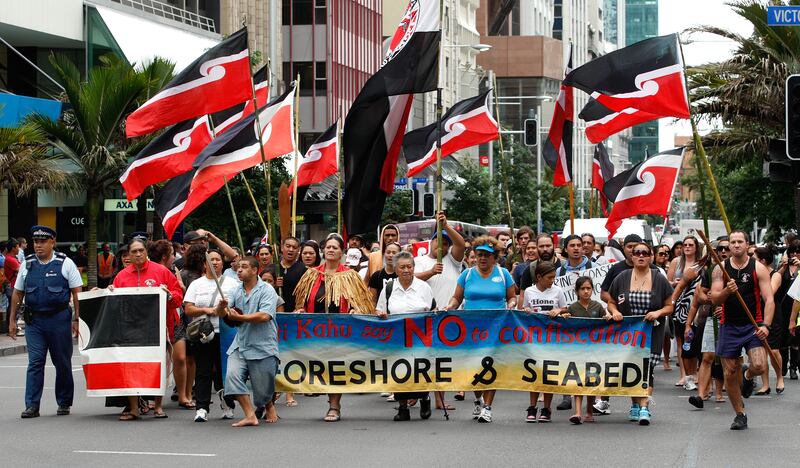
He also said the proposal created uncertainty around the future of the case and could significantly delay or restrict proceedings. However, he argued it did not remove the responsibility major emitters carried for the emissions they continued to produce.
RNZ reported Justice Minister Paul Goldsmith said the courts should not be used to establish a “parallel” system of climate accountability, pointing instead to existing frameworks such as the Climate Change Response Act and the Emissions Trading Scheme as the proper mechanisms for emissions management.

‘Not a parallel system’
Smith rejected that framing, arguing the cases relied on ordinary legal principles already recognised within the court system. He said weakening or removing these legal pathways would disproportionately affect Māori and frontline communities already experiencing climate impacts and with the least access to political influence.
“These cases are not a parallel system. They use established legal tools like negligence, public duty, and statutory interpretation, and they are the normal legal system being applied to modern climate harm. It’s not a parallel system at all.”
Requests for comment were sent to Climate Change Minister Simon Watts and Justice Minister Paul Goldsmith regarding the proposed law change, including concerns raised by critics about access to justice, judicial independence, and whether existing climate policies and emissions reduction mechanisms are sufficient to address climate harm.
Te Ao Māori News also approached all companies named in the case brought by Smith for comment, including Fonterra, Genesis Energy, Dairy Holdings, New Zealand Steel, Z Energy and BT Mining.

Genesis Energy said it believed the Climate Change Response Act remained the primary mechanism for addressing climate change, and that it was the role of the Government, rather than the courts, to develop climate policy and legislation. The company said consistency was important to support long-term investment decisions tied to the transition to net zero by 2050, pointing to plans to invest more than $2 billion by 2032 into renewable generation, battery storage and back-up energy supply.
Z Energy said it welcomed the Government’s decision to progress legislation reinforcing the Climate Change Response Act as the primary mechanism for addressing climate change. It said “clear and consistent policy direction is critical” to enable long-term investment decisions and support the energy transition.
New Zealand Steel acknowledged the announcement and said it will review the details once available.
The wider legal challenge
Smith also voiced support for the legal challenge brought against Climate Change Minister Watts over the Government’s emissions reduction plan. Lawyers involved in that case argue the plan relies too heavily on forestry offsets, particularly pine plantations, rather than reducing emissions at source.

Smith said his own case ultimately sought to answer a straightforward legal question: whether major companies could be held responsible for the climate damage caused by their emissions.
He said the aim was not financial compensation, but legal recognition of responsibility, with the broader hope of driving behavioural change at the source of emissions and establishing precedents future communities could rely on.
Despite the proposed law change, Smith maintained the core issue remained unchanged: climate change was accelerating, and communities were already bearing the consequences.
Read more: This amendment sits within a broader climate and energy policy shift, including the Crown Minerals Amendment Bill, which has drawn criticism over weakened corporate accountability and long-term clean-up responsibilities for fossil fuel activity.
Māori and Pacific backlash
The National Iwi Chairs Forum has also raised serious concerns about the proposed amendment, describing it as a significant erosion of legal accountability, access to justice, and the constitutional role of the courts in Aotearoa New Zealand.
“This removes accountability from some of the country’s largest emitters at the very moment communities are already bearing the cost of climate harm,” said Marama Royal, Pou Chair for Pou Take Āhuarangi of the National Iwi Chairs Forum.
Royal rejected the Government’s position that climate-related harm should be managed through Parliament and the Emissions Trading Scheme.
“The courts exist precisely to consider complex harm, evolving duties, and questions of justice,” she said.
“The Crown cannot legislate away legal responsibility.”

Youth-led climate justice network 350 Pacific also criticised the proposed amendment, saying it contradicted the recent International Court of Justice Advisory Opinion, which found states have obligations to prevent climate harm, protect human rights, and act in the interests of present and future generations.
A United Nations General Assembly vote on operationalising the advisory opinion is scheduled for May 20 in New York.
“These amendments are an attack on mana whenua as well as our Pacific regional homes. It is unjust that those contributing the most to the climate crisis face no consequence whilst our Māori and Pacific communities are left to bridge gaps we did not create,” said Bethany Mataiti of 350.
“The government must reverse these amendments, and voters should absolutely remember these actions as this year’s national elections approach.”