

Treaty Negotiations Minister Paul Goldsmith says Crown-Māori relations are in “good shape” and that long-running Ngāpuhi settlement talks are gaining momentum, despite growing criticism from Māori leaders who argue the Government has caused significant damage to its relationship with Māori.
Goldsmith made the comments following his appearance before Parliament’s Māori Affairs Select Committee during scrutiny week, where he pointed to progress on Treaty settlements as evidence the Crown and Māori continue to work constructively together.
His assessment comes off the back of a recent urgent inquiry at the Waitangi Tribunal into the Treaty clause review.
The Tribunal heard evidence from constitutional experts, Māori leaders and claimants who argued the Government’s approach represents one of the most significant deteriorations in Crown-Māori relations in recent history.
Goldsmith rejected suggestions there was a single Māori view on the Government’s direction.
“There are nearly one million Māori New Zealanders, and there are a wide variety of views amongst that vast population, as you would expect.
”Some support NZ First, some support National, some support a range of parties, and some have a focus on cost of living, making sure their kids get to school, a whole range of concerns. I don’t think it’s right to assume there is some single Māori view on any given topic.”
The Minister said Treaty settlement progress should be considered as part of the progress being made for Maori.
“It needs to be considered in the broader context that there are a wide variety of views, and we want to make progress.
“The good news in this hearing is progress on historic Treaty claims. In the last year, we have had 20 areas of progress, passed six pieces of legislation, and we are getting things done.”

Figures provided by the Minister’s office show 21 Treaty settlement milestones were achieved during 2025 and 2026, including six settlements enacted through legislation. They say a further 20 milestones are expected over the next 12 months.
“Real momentum” Ngāpuhi settlement
A significant focus of Tuesday’s hearing was the long-running Ngāpuhi settlement process, with Goldsmith saying negotiations were beginning to gain momentum.
Ngāpuhi remains the country’s largest iwi yet to settle its historical Treaty grievances with the Crown.
Goldsmith said 10 groups representing northern hapū had now been identified to participate in negotiations, marking another step in a process that has spanned more than two decades.
“There is real momentum. The process is that you need to first go through a mandating process where groups get a mandate from their group to start the negotiations, and we have divided up the north in various parts.
“Once that is completed, we will start the negotiations.”
Goldsmith said mandating work was continuing across several parts of Te Tai Tokerau, including Whangaroa, the Bay of Islands and Hokianga, before formal negotiations could begin.
While declining to put a firm date on a settlement, Goldsmith said he hoped the process would be in a position to move more rapidly after next year’s election.
“We’re hoping that if we’re fortunate enough to be returned to government after the election, we’ll be in a good place next year to really crack into it.”
He acknowledged progress could be slow but said neither side wanted to force the process.
“There is good progress. Not everything is concluded. There is a tension there. Pace is something both sides tend to be comfortable with. We aren’t going to rush it or force it, but we want to get things done.”
Asked about the timeframe for a final settlement, Goldsmith suggested significant work remained ahead.
“We are hoping if we are fortunate to return to government again, we will be in a good place to crack into it.”
The Minister also indicated he was not ruling out future discussions around sovereignty clauses as negotiations progress.
The issue has been contentious in previous settlement negotiations, particularly following disagreement between the Government and Te Whānau-ā-Apanui over an “agree to disagree” clause relating to sovereignty.
Goldsmith said such clauses were not the Government’s preferred approach but would likely form part of future discussions with Ngāpuhi.
“That is something that we have not agreed to in the past, so we have very clear ideas about that.
“But that is very much part of the discussion we are going to be having over the next couple of years.”
The Government has also signalled a preference for a single commercial settlement for Ngāpuhi alongside multiple cultural settlements.
Māori-Crown relations in ‘good-shape’
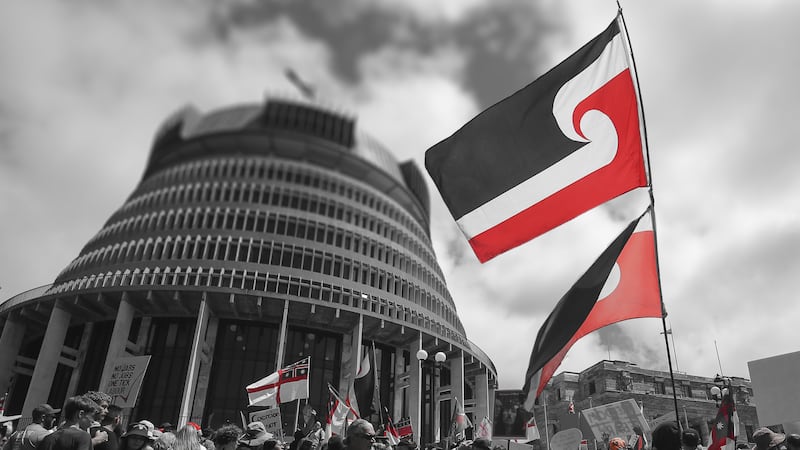
Despite criticism from opponents who argue the coalition’s policies have strained relationships with Māori, Goldsmith maintained the overall relationship remained positive.
“I think it is in good shape as a country.
“Ultimately, people will have a different opinion on that. My opinion is that it is in good shape, and there is much progress we are making together, focusing on the things that will make a difference.
“I think it is going well.”
When pressed on what he meant by “good shape”, Goldsmith pointed to progress across several ministerial portfolios.
“Wearing my ministerial hats, we are making good progress on Treaty settlements.”
He also highlighted reductions in overall victimisation rates, which would have more impact on Māori, and Government support for Te Matatini as examples of positive outcomes for Māori communities.
However, Labour Māori Development spokesperson Willie Jackson said Goldsmith’s assessment was at odds with what many Māori leaders have been saying publicly.
Asked for his reaction to the Minister’s comments, Jackson questioned Goldsmith’s understanding of the history and politics surrounding Treaty negotiations in Te Tai Tokerau.
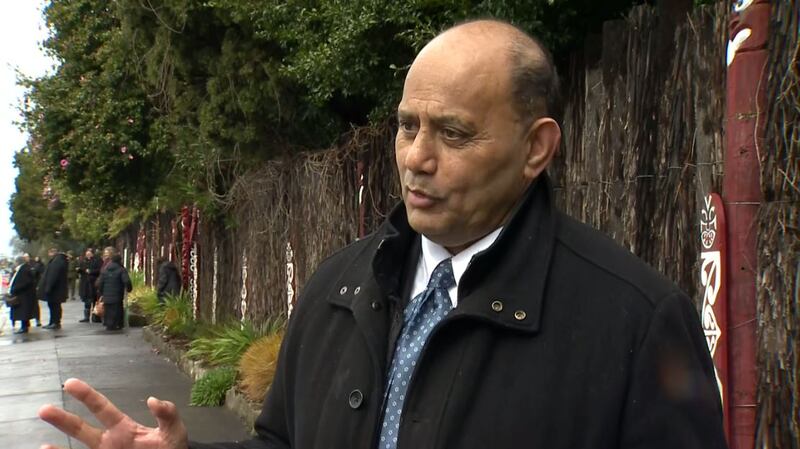
“He āhua rerekē tana kōrero whakautu ki a mātou. Ko te mea hoki kāore tino mōhio ia ki te hītori o Te Tai Tokerau.
“He nui ngā porotēhi. I mōhio mātou ki tā rātou whakaaro e pā ana ki te tino rangatiratanga. He tino uaua mō te minita i tēnei wā i te mea hoki kei te mōhio mātou kāore ia e whakaae ki te whakaaro e pā ana ki te tino rangatiratanga.”
Jackson also rejected Goldsmith’s claim that Crown-Māori relations were in good shape under the current Government, pointing instead to comments previously made by Kiingitanga spokesperson Tuku Morgan.
“Tuku Morgan was very clear that it was at an all-time low. He thought it had never been worse in terms of the whanaungatanga between the Crown and Government.”
Jackson said while Māori leaders remained committed to maintaining relationships with the Crown, that should not be mistaken for agreement with the Government’s direction.
“But at the same time, people like Tuku, whether it’s Tuku, whether it’s our other leaders, they know the relationships have to continue.”
He argued issues such as Treaty settlements, the Treaty clause review and broader Government policy could not be separated from wider concerns about Crown-Māori relations.
“Everything’s linked.”
Takutai Moana reforms
Goldsmith also defended the Government’s controversial changes to the Marine and Coastal Area (Takutai Moana) Act, rejecting claims the reforms were harmful to Māori as put to him by members of the Māori Affairs select committee.
The Government’s Takutai Moana reforms followed years of litigation over the Marine and Coastal Area Act 2011, which allows iwi and hapū to seek recognition of customary rights and interests in coastal areas.
The coalition argued recent court decisions had made customary marine title easier to obtain than Parliament originally intended and moved to restore what it described as the original legal test.
The changes prompted strong opposition from iwi, Māori legal experts and opposition parties, who argued the legislation undermined existing claims and would make it harder for Māori to have customary rights recognised.
Goldsmith said the Government believed the legislation was intended to strike a balance between recognising Māori customary interests and ensuring all New Zealanders retained an interest in the coastline.
“The whole point of the Takutai Moana legislation was to find a balance between the particular cultural rights and interests of Māori in the seabed and foreshore areas, but also recognising that all New Zealanders have an interest in what happens on their coastline.”
Goldsmith said the coalition believed court decisions had shifted Parliament’s original intent and that legislative change was necessary to restore that balance.
He said four Takutai Moana cases were expected to be reheard over the next year as a result of the changes, although he did not have figures on how much of the $15 million allocated for the rehearings had been spent.