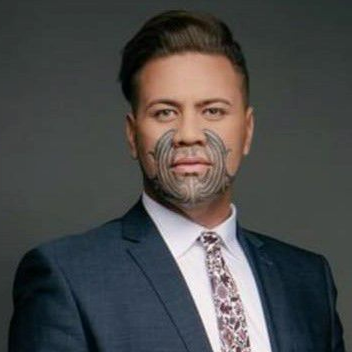

“My PhD research has revealed very beautiful truths about my own identity,” says Arapeta Hākura.
As moko kanohi experiences a powerful resurgence across Aotearoa, Hākura’s decision to receive facial moko has highlighted the evolving conversations around how traditional practices apply to irawhiti and gender-diverse whānau.
Traditionally, moko kanohi is heavily gendered, with kauae worn by wāhine and mataora by tāne. However, a growing number of irawhiti are exploring how to express their identity through moko that accurately reflects who they are.

Te Ao Māori News sat down with Hākura at Elam School of Fine Arts, University of Auckland, where they teach, to reflect on their identity, the six-year academic journey behind their markings, and the debate surrounding gender roles within traditional tikanga.
“I am irawhiti, one who navigates between ira tāne and ira wahine, the masculine and feminine energies,” Hākura says. Following years of deep research, Hākura’s moko kanohi is a sacred reflection of their true self.
Six years of research, a lifetime of truth
Hākura grew up grounded in a progressive whānau that encouraged them to hold their own mana.
Working as a kairaranga and kaiako at the Elam School of Fine Arts, Hākura spent six years undertaking PhD research into their whakapapa and identity.
“Once I sat in that for six years, I was like, okay, it’s time to receive my moko kanohi,” Hākura says.

This realisation led to careful reflection on receiving a moko kanohi outside of a rigid traditional structure.
“I went through phases being like, oh do I get a kauae, kauae what is my ira, my relationship to what a kauae is and what the mana and the tikanga around it, then also mataora, what is my position within that.”
Finding the design and the decision
Hākura ultimately turned to tā moko artist Tristan Marler, who has worked with Hākura for eight years, to apply the markings.
“That was the first moko kanohi I did with a trans client,” Marler says. “I did their pūhoro a few years ago, and I was happy to be guided through that space.”
Guided by their kuia, Hākura landed on specific areas of the face that bridge both worlds.
“Yeah, so I landed on the tū and the mau tāringa. The ngutu and the mau tāringa are both areas that those who are tāne and wahine both occupy. So for me that seems like a very appropriate space to embody my being as someone who is in those two.”

Marler emphasises that the recipient’s personal history and identity drive the design process.
“It’s not my place to be deciding what goes where, what patterns are used; they bring their kōrero, they bring their whakapapa, and then I’ll interpret that into a moko.”
Navigating tradition and tikanga
While some debate the boundaries of facial moko, experienced tā moko artist Te Kanawa Ngarotata notes that these discussions are part of an ongoing wānanga within te ao Māori.

“Ehara i te mea he mea hou tēnei āhuatanga, ko ētahi o ōku whaea o te kāinga he irawhiti, engari e mau nei ki te moko kauae,” Ngarotata says. “Ko te whakautu kei tēnā tohunga, kei tēnā tohunga tōna ake mana, tērā pea me waiho mā tōna iwi e tiaki, e tono rānei ki tēnā whakawhiwhinga.”
For Hākura, the journey comes down to staying grounded in tikanga while being authentically themselves.
“My whānau... they keep me in check, they make sure that I’m tika with my own relationship to te ao Māori and how I embody that. They also taught me to be grounded in tikanga but also be yourself and hold your own mana because that is where change counts.”