

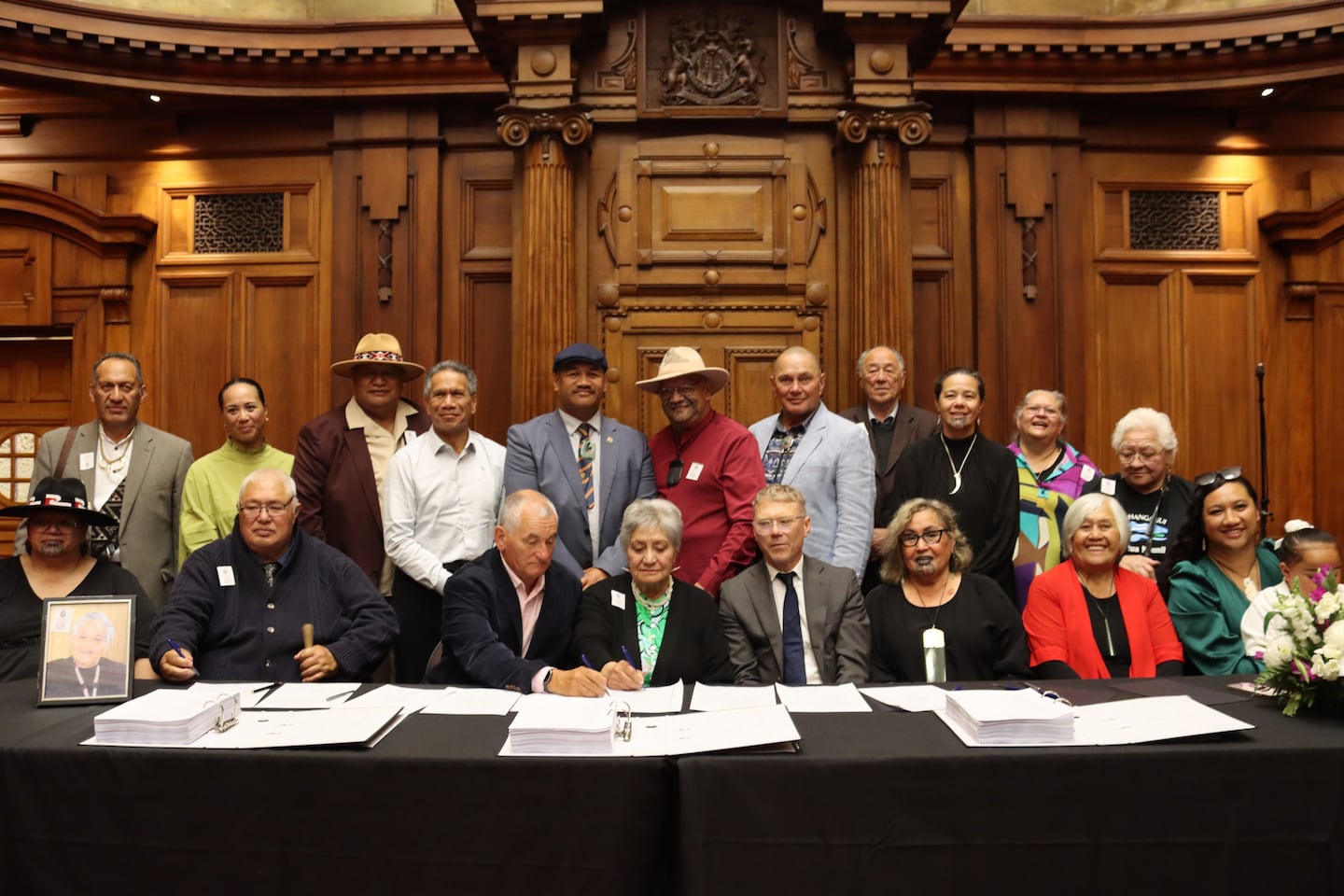
Years of Treaty settlement negotiations came to a close at Parliament on Thursday as Whanganui hapū representatives initialled He Rau Tukutuku, the Deed of Settlement with the Crown.
Lead negotiator Ken Mair said the ceremony marked a major milestone in a “long and tiring” Treaty settlement journey.
“It closes a chapter of the negotiations, but not the journey,” he told those gathered at Parliament.
“For generations now, ngā hapū o Whanganui (the sub-tribes of Whanganui) have carried the weight of history on our shoulders. The journey has not been easy. At times it has been deeply painful.”
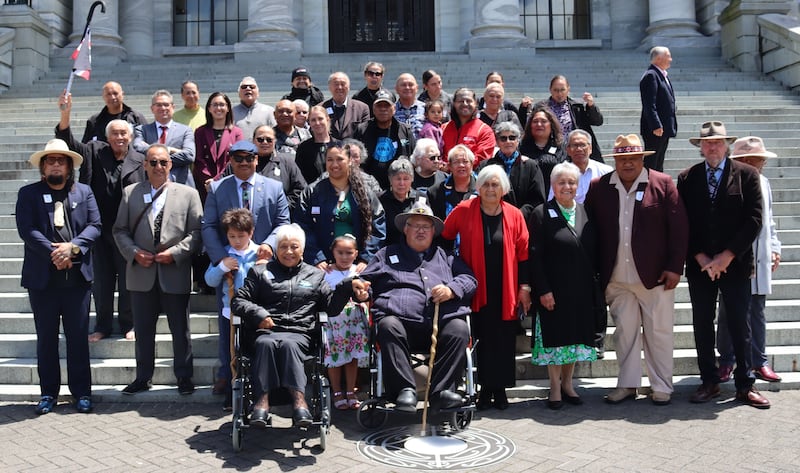
Mair said the settlement would not erase the hurt nor restore all that had been lost, but offered a pathway to rebuild what had been fractured.
“Clay and steel do not bind and yet here we stand. After years of fronting up, we’ve shaped a new relationship, one grounded in our own tikanga and world view.”
Settlement was “a gesture of courage – a line drawn in the earth that says the conflicts rest here”, Mair said.
The deed sets out the Crown’s redress to Whanganui for historical breaches of the Treaty of Waitangi. It includes more than $50 million in redress – $30 million in financial compensation, $4.5m in interest, and a $15.5m cultural revitalisation fund.
The cultural fund, Kia Mana Motuhaketia, provides $3m for te reo Māori revitalisation, $3m for marae projects, and $500,000 to establish a joint statutory reserve board with Whanganui District Council.
The deed also contains a formal Crown apology to the iwi and hapū for failing to uphold responsibilities as a Treaty partner.
“The Crown failed to protect their collective control and instead promoted legislation that facilitated the alienation of land and resources,” it states.
These breaches left Whanganui hapū feeling marginalised and experiencing socio-economic deprivation.
The Crown acknowledges actions that caused significant prejudice, including its conduct during 1840s warfare, the unfair and incomplete 1848 Whanganui block transaction, and the Crown’s role in provoking war in the 1860s.
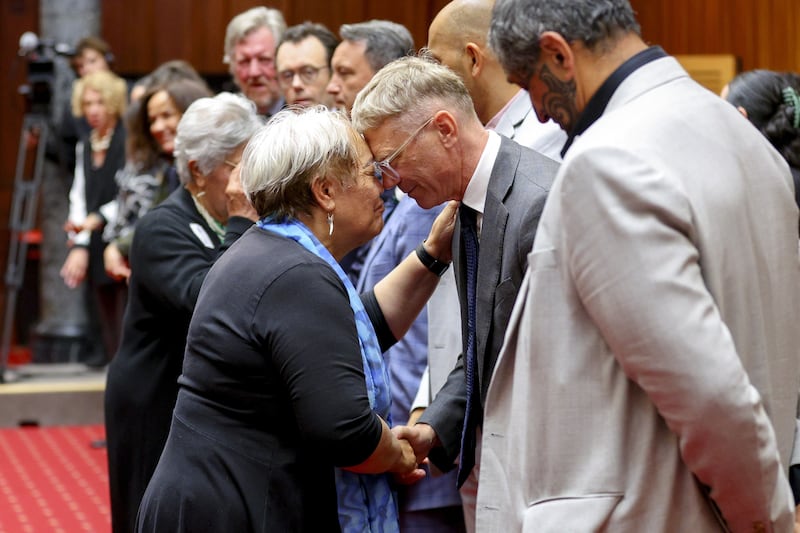
It also recognises the severe impacts of native land laws and the extensive loss of land through mechanisms such as public works takings.
Treaty of Waitangi Negotiations Minister Paul Goldsmith said the initialling marked a significant and historic step toward settlement.
“I look forward to continuing our work together and seeing this settlement through its final stages.”
He said the package included the vision of Te Puna Hapori, a hapū-led initiative to redesign justice services in Whanganui.
“Our hope and aspiration is it will contribute significantly to reducing the trauma that lies with much of the offending in the justice space. It is a real opportunity,” Goldsmith said.
Twenty-seven culturally significant sites will be returned to hapū, including locations at Kai Iwi, Kauarapaoa Road, Mōwhānau, Pitangi Village, Rapanui Road and along Whanganui River Road.
Additional sites will be vested as scenic, local purpose or historic reserves, including Pākaitore (Moutoa Gardens).
The deed confirms eight place name changes, among them Atene Pā to Kākata, Koriniti Pā to Ōtukopiri, Pūtiki Pā to Pūtikiwharanui-a-Tamatea-pōkai-whenua, Sparrow Cliff to Kaimatira, and Wanganui to Whanganui.

Ngā Hapū o Te Iwi o Whanganui will have the option to purchase a number of sites, including part of Lismore Hill and the Lismore Sand Crown forestry block, part of the former Aramoho School, and the Te Puna Hapori site – the location of Whanganui’s new multi-million-dollar courthouse and police station, still under construction.
The hapū will also receive rights of first refusal for 185 years over 493 Crown-owned properties.
Mair said an overarching tikanga- and values-based framework sits at the heart of He Rau Tukutuku and will be reflected in relationship agreements with 24 Crown agencies.
The deed also establishes a new wellbeing framework, Toitū Te Whānau, under which marae, hapū and the wider community will work alongside the district council and government agencies to deliver whānau-centred social services.
After the initialling, Whanganui MP Carl Bates said he was happy to witness the milestone.
“It was brilliant to have been able to support it in my role as the local MP over the last 24 months,” he said.
The settlement package – negotiated by the Whanganui Land Settlement Negotiation Trust – will now go to the hapū for ratification.
“The most important next step is to ensure that our people look at the documents and vote on whether the settlement should proceed,” Mair said.
“Read the documents, ask the questions, inform yourselves – and when the time comes, vote. Decide whether this is the pathway you want us to take together.”
Mair said voting would open in mid-January, after the annual two-week tribal journey on the Whanganui River, and run through to March.
The settlement area covers Whanganui city and the lower reaches of the Whanganui River up to Pīpīriki.
LDR is local body journalism co-funded by RNZ and NZ On Air