

This article was first published by APTN News in Greenland.
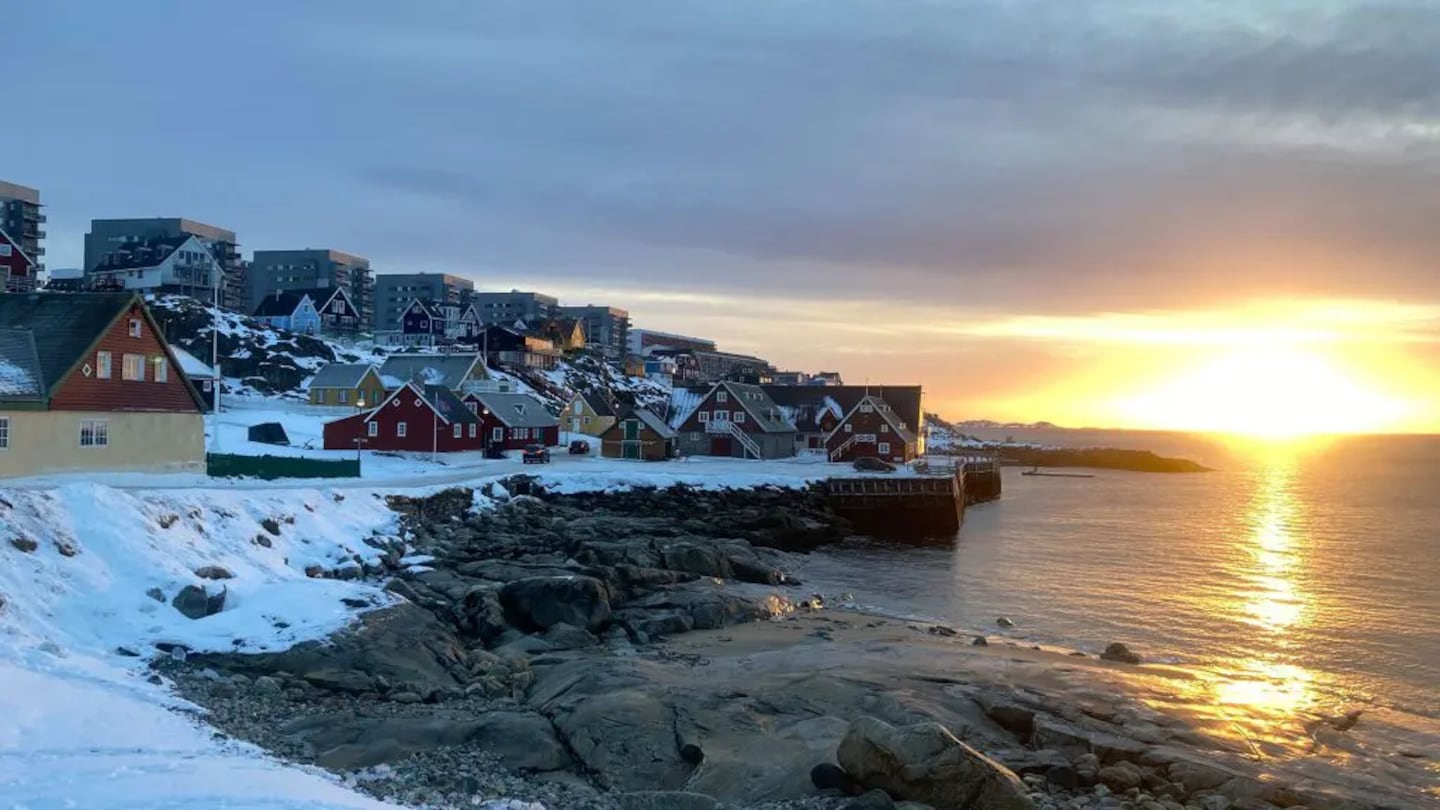
Culture Night is a big event in Nuuk, Greenland. The evening takes place every January and, contrary to its name, it starts in the morning in many locations and stretches into the evening.
Not only are art galleries and cultural centres free to the public, but even the police station, fire hall and national parliament open their doors to greet locals and visitors alike.
Outside the police station, cars displayed their flashing blue lights and occasionally raised their sirens for passing children, invoking an atmosphere of emergency after weeks of tensions brought about by U.S. President Donald Trump’s threats to invade and annex the island, whose population is 90 per cent Greenlandic Inuit (Kalaallit).
All week, the streets had been full of foreign media, APTN News included. Now the same media remained as tourists, joined by the city’s residents, who enjoyed open entry to sites like the Nunatta Isiginnaartitsisarfia (National Theatre of Greenland), the Nunatta Katersugaasivia Allagaateqarfialu (Greenland National Museum & Archives), and the Nuutoqaq (Nuuk Local Museum).
At the small but labyrinthine Nuuk Kunstmuseum (Nuuk Art Museum), visitors enjoyed free access to a surprisingly large collection of classic and more modern works, largely by Kalaallit, but also by other Indigenous artists, including Sámi from the north of Norway, Sweden, Finland, and Russia.
Events were also ongoing at the Katuaq Cultural Centre, where soundman Angunnguaq Larsen has been busy all week. Two days earlier, he had run sound for the massive English-language press conference Prime Minister Jens-Frederik Nielsen held for international media.
That press conference followed Trump’s announcement that he was stepping back from his threat of military assault, and in the days that followed, most people APTN spoke with expressed tentative relief.

“Lots of people have been scared of what Trump has been saying,” Larsen told APTN over coffee among the shifting crowds at the Katuaq Cultural Centre on Saturday. “People feel insecure, either if we’re going to get invaded or not. It’s the biggest military force in the world.”
For Larsen, there was always a sense that a real invasion was unlikely.
“I’ve been seeing some statements from leaders from Europe that if Trump ever put a foot here in Greenland, they will take out the military bases around Europe,” he explained. “So somehow I felt safe that he wouldn’t come here. But always in my back mind that he could actually do it. But I wouldn’t spend my time to be scared. I didn’t want to use my energy on that.”
Ultimately, Larsen said, whatever happened politically was outside of his control, and he avoided the news as much as he could.
“I just turned off the news whenever Trump came on, because whatever that comes out from his mouth is like bullshit,” he said. “I kept telling my kids, if this thing is coming to Greenland, we just have to be together with this. But we saw all the response from the whole world, actually, that the whole world is with Greenland.”
Running sound for the Cultural Centre is a side job for Larsen, who’s far better known as an actor and a musician. For more than a quarter century, he’s played in numerous locally renowned rock bands, but he’s best known for his co-starring role in 2009’s Nuummioq (The Man from Nuuk), the first feature-length film ever made entirely in Greenland.
He also had a role as the Greenlandic prime minister in the celebrated Danish political thriller Borgen, as well as a role in the fourth season of HBO’s True Detective, starring Jodi Foster.
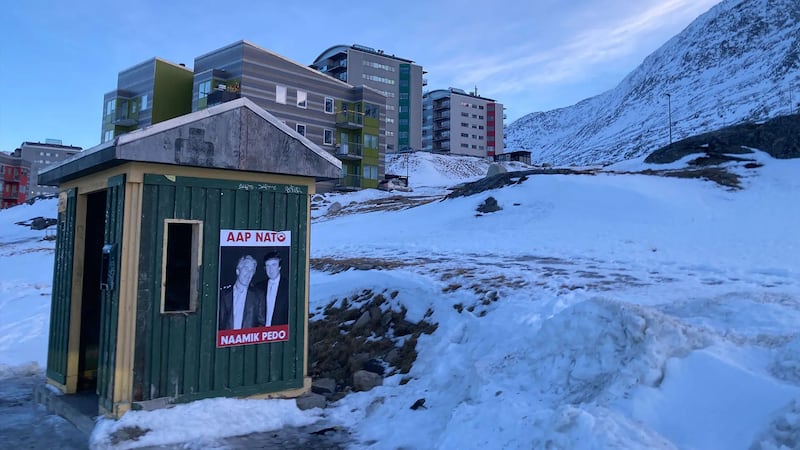
Larsen underlined how the tensions between Greenland and Trump have been ongoing for over a year now, dating back to the president’s visit to Nuuk and U.S. Vice President J.D. Vance’s visit to the Pituffik Space Base missile-defence facility in the north of the island last March.
“We Inuit people are not for attention somehow,” he said, but “last year we had big YouTubers from America doing their selfies and giving [U.S.] dollars for the kids outside the stores. It’s like, what the f**k is going on?”
He recalled with satisfaction watching some locals tearing up the American dollars and grinding money and MAGA [Make America Great Again hats worn by Trump supporters] hats into the snow with their boots.
“We didn’t take those dollars [from] America, no,” he said.
The last year, and especially the last two weeks, Larsen argued, have changed Greenland’s relationship with Denmark, of which it is an autonomous territory with a fraught history.
In particular, he cited the “Spiral Case,” a national scandal in which hundreds of Kalaallit women and girls as young as 12 were forcibly implanted with IUDs by Danish physicians between the 1960s and 1990s.
“It’s been strange how [Danes] treat us, they don’t listen,” Larsen said. “But as soon as a white, rich man comes and says something, it’s all on the front pages. How can we make a voice heard?”

The previous day, Danish Prime Minister Mette Frederiksen had visited, something Larsen said had begun happening far more frequently since Trump began threatening annexation.
“Wow, now they love us,” he said with a smirk. “But we are cautious of what happened before in the last 300 years. So we don’t take every word for granted. We want to see action that benefits,” he said.
A frequent visitor to Iqaluit and other parts of the north of Canada, Larsen reported proudly that even more Kalaallit speak their own language than Inuit in the four Canadian regions of the Nunangat.
“We speak our language from Qaanaaq, up, up north, to the southernmost point in Greenland, and in East Greenland,” he said. “So we still have our language, and kids are taught in Greenlandic at the schools about our language, with the language, and we speak our language very well.”
Nuuk’s population is roughly 15 per cent Danish, but Larsen said Danes’ interest in the Greenlandic language (Kalaallisut) is limited.
“Let’s say ten Danes come here to Greenland,” he said. “Maybe one out of ten will try to learn Greenlandic, but they go back within two years to Denmark.”
Larsen is uncertain how the events of the last year and the last two weeks will affect the future of relations between the island and Denmark, now that international media has taken notice of Kalaallit Nunaat, as Greenland is known to Kalaallit.
“Since Trump just kept on telling that he wanted Greenland, the whole world actually started to listen to the Inuit,” he said. “They say, ‘hey, we are with Greenlanders and the Inuit,’” he said. “Also the Danes, ‘We are with Greenland.’ But why didn’t we do that before? It’s strange to see how things can change so fast.”
As dusk was falling over Nuuk’s Colonial Harbour, site of the oldest buildings in the city, a man and a woman stood watching a dazzling sunset.
The man and woman asked not to be identified in international news, but talked about the rising cost of living in Nuuk, which struggles with similar housing issues as many Inuit communities in the north of Canada.
They repeated complaints APTN heard in numerous conversations, that black mould is common in Nuuk buildings and has forced the closure of schools and housing in a community where the waitlist for new homes has thousands of names and an average delay of decades.
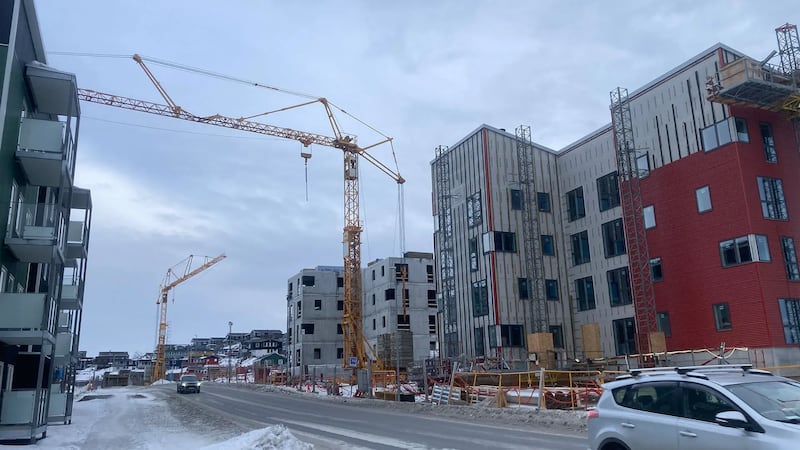
Nuuk (pop. 20,000) is a decidedly modern looking city with dozens of large apartment blocks as well as older-style wooden houses, and construction cranes are active all over town, mostly building what seem to be more residential units.
Given the extreme demand, however, it will take years for them to meet the need.
Meanwhile, the man reported, housing is getting more expensive, and so is food. He joked he’d had to cancel Netflix in order to be able to afford a monthly piece of cheese.
The woman talked about how her teenage daughter asked whether an American invasion would prevent her from hunting reindeer with her grandfather as she loves to do. She said she told her daughter the reindeer hunt probably wouldn’t be affected by an invasion, as she predicted the Americans wouldn’t have much interest in parts of Greenland outside Nuuk.
Even if they did, she said, they wouldn’t know how to live there comfortably, certainly not in the traditional manner of Kalaallit.
Near the water’s edge in old Nuuk, historian Ujammiugaq Engell was greeting visitors at the Nuutoqaq (Nuuk Local Museum), where she holds the title of museum leader. She described herself as tired.
“We’re all so exhausted,” she said. “We’re all so overwhelmed. Obviously, the political issues that we’re dealing with right now have been intense. Being the focus of everyone’s attention has been a little much.”

Engell and her team had been trying to put together an exhibition for the museum showing highlights from the recent past. They had planned to highlight a timeline of the last year, before realising that it needed to extend much farther back. As a historian, she said, it was hard not to see the lines connecting the events of the present to the past.
As international journalists have been descending upon Nuuk for a year, Engell reported that some of the most fraught interactions have been with reporters from Denmark. That, she says, is nothing new.
“Oftentimes, when they talk to us, they’re like, ‘Why are you so angry at us?’ And it’s like, ‘What are you talking about?’”
Like a number of younger Kalaallit, as is equally the case with younger Inuit in the north of Canada, Engell has tunniit, Inuit tattoos. These traditional inkworks consist of sparse lines and geographic shapes in a variety of locations on the body, including the face, wrists, shoulders, and thighs.
While for many years tunniit were condemned or banned by colonial powers, in recent years they have become an increasingly popular means of asserting Inuit identity and pride across the circumpolar north.
Engell recalled a recent conversation with a Danish journalist whose first questions was whether she had any tattoos, and when she answered yes, he asked her why.
“He was like, ‘I just think it feels like a provocation,’” she recalled. “And I was like, ‘Sir, we will have to end this interview almost immediately if you don’t rephrase your question.’ He was like, ‘No, I’ve seen these tattoos everywhere in town. And I just think it’s such a statement of not wanting to be a part of Denmark.’”
“My mind was blown,” she said. “Because I was like, ‘This has nothing to do with you.’”

Engell has some Danish family and went to school in Copenhagen. She reported during a visit there, an old university friend told her he was glad that she hadn’t tattooed her face.
“He was like, ‘It feels so angry.’ And I was like, ‘Oh, is it about you white people and your way of inserting yourself into this situation?’”
She told her old friend that she did have tattoos, and would likely get her face tattooed at some point. One of her tattoos, she noted, honours her eldest daughter, and another is for her youngest.
“I have tattoos that are connecting me to my culture,” she said. “And my roots. And they have nothing to do with my relationship to my Danish side. Or the Danish history. Or colonial history. Or anything else. It’s not about you, honey.”
Yet she noted some Danish journalists, forced to pay closer attention to Kalaallit due to the last year’s events, are softening their tone. Previously, she said, she frequently felt reports by Danish journalists on Greenland were “crushing.”
However, she named a popular Danish journalist who had newly acknowledged that, having spent more time in Nuuk with Greenlandic people, he now realised the issues Kalaallit were facing were completely different than the issues he and other Danish media figures previously thought.
“Hearing him admit to that sort of mentality was really, really nice,” she recalled. “It felt so validating. And we don’t often need the validation. But the validation of having somebody say, ‘Okay, we were wrong’? It’s just nice sometimes. And I do think there is hope.
“I do believe that other parts of the media are starting to change their focus,” she said. “I do believe that more and more people are starting to understand that Greenlanders or Inuit or people from Kalallit Nunaat speaking about independence doesn’t necessarily have anything to do with anger towards Denmark or whatever they are seeing or hearing when we talk about independence.
“There are idiots on both sides of the fence,” Engell said she wasn’t the kind of independence advocate who felt Greenland needed total separation from anything Danish as quickly as possible. Personally or professionally, I don’t think that’s a reachable goal. Not within this generation at least. We’re so mixed, many of us.
“We have relations back and forth and so much history that goes back and forth. And I do think that as humans we’re also stronger when we stand together.”
The threat of an American invasion has increased tensions for many Kalaallit, Engell said, and the tensions are complex. Unlike most Kalaallit, Engell has experience with Americans after spending a year of high school studying in Oklahoma.
She recalled a reporter asked her hypothetically whether, since she spoke fluent English and had lived in the U.S., she would accept a job working with the Americans after they had invaded. Doing so, the reporter noted, would allow her to stay in her home, and not uproot her family.
“That was the first time that anyone had ever put me in a position where I had to go through that thought experiment,” she said. “And I was like, ‘I don’t know. I don’t know.’ On one hand, of course, I want to stay here. I want to fight for this place. I want to fight for my people. I want to fight for my country.
“I also have two little kids that are both girls,” Engell added. “I am not raising them in an American system whatsoever. I am not having them be anything in an American system. Especially because they are girls. Not having it. And I was just torn. I don’t have an answer at all.”
At least for the time being, that immediate threat has abated. But Engell said that a lot of damage has already been done.
“There is such a large rift that has torn itself between us and people on the other side of the pond,” she said, “so we have to see what is going to happen. Even if the leader of the Trump administration disappeared tomorrow, there is still a lot at hand right now.
“There is still a lot of demands that have been made, and wishes that have been made — and threats that are not going to disappear. Even if the leader of the administration does. And I think that is worth considering.”
Culture Night continued as APTN’s reporters headed back to their hotel in a part of the city where old industrial units are being joined by fresh housing, an indicator of the speed with which Nuuk is modernising.
However, the power of the north asserted itself all the same: around 10:30 that night, high winds caused a power outage for the entire city that lasted well into morning.
For some it was clear that the winds had knocked the power out, but others took to social media to ask whether the invasion was happening after all.
By Jesse Staniforth of APTN News.