


People from all different backgrounds attended the Waitangi Treaty Grounds to celebrate Aotearoa’s national day. Te Ao Māori News spoke specifically to tauiwi (non-Māori) on why our founding document Te Tiriti o Waitangi is important to them.
Alexandria Bear of the Muskoday Nation in Saskatchewan, Canada, described the commemorations as beautiful, intense, powerful and energetic.
“I wanted to see where it all began. I wanted to hear the history, the culture, the stories, and I wanted to feel the energy from our Māori relatives,” she said.
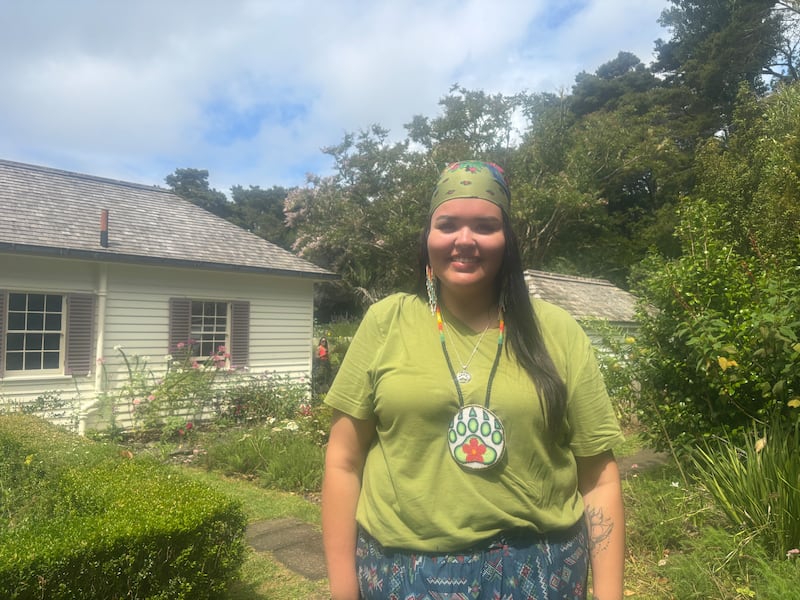
“It’s everything I could have imagined and more.”
Bear said she was proud to represent her nation and eager to make cross-cultural connections.
Asivak Koostachin is from Attawapiskat First Nation in Northern Ontario on his mother’s side, and Inuvik in the Northwest Territories on his father’s side.

Koostachin came to Waitangi by chance. He is currently in Aotearoa visiting friends he met at the Māoriland Film Festival in Ōtaki last year, where he screened his film Angela’s Shadows - a period piece set in 1930’s Northern Ontario.
“It feels really good to be here,” he said. “I feel solidarity, I feel empowered, I feel hope.”

Fatima Sanussi is of Sudanese and Ethiopian descent but was raised in South Auckland. She says for her, having justice for Te Tiriti is deeply personal.
“Growing up here, it’s my duty and responsibility to stand with tangata whenua,” she said.
“I have to make sure that I’m upholding the rights of tāngata whenua and standing for Te Tiriti justice, because I come from a background that has a long history of colonialism and Western imperialism.”
Sanussi said that standing for Te Tiriti also meant standing for African struggles and for all people who were colonised.

Dani Pickering’s whakapapa traces to the Scottish Gàidhealtachd, the Highlands and Islands of Scotland. Born in Tāmaki Makaurau, raised in Seattle on Duwamish land, Pickering now lives in Te Whanganui-a-Tara.
Ia (they) attended Waitangi for the Tīpuna Project, which is a creative, community-based research project involving both Māori and Pākehā rōpū.
The research involved several wānanga over the past few years, exploring how people relate to their tīpuna.
“I’ve been looking at how our relationships with our ancestors could be developed or recovered in ways that fortify our commitment to Te Tiriti and Matike Mai,” Pickering said.
They explained that language loss is deeply tied to economic pressures, noting that languages survive longest in their heartlands, areas that have often been economically devastated.

Rana Hamida is a Palestinian woman whose parents are survivors of the Nakba in 1948, which led to the establishment of the state of Israel. Her parents were displaced to Syria, where Hamida was born. When war broke out, the whānau came to Aotearoa as refugees.
Hamida said she came to Waitangi with a sense of responsibility to honour Te Tiriti o Waitangi, which she believes has been disrespected by the current government.
She pointed to moves by the coalition government to remove references to Te Tiriti o Waitangi from policy and legislation, as well as the ACT Party’s controversial Treaty Principles Bill, which seeks to redefine the principles of Te Tiriti.
“There’s absolutely no other place right now that I would be standing, with the people of the whenua, considering I’m not allowed to go back home to Palestine,” she said.
“I wish that I contribute with aroha and tautoko as tangata Tiriti, and I also hope to see the seeds that we are watering sprouting.”
Across the Treaty Grounds, Te Ao News captured the voices on how Te Tiriti o Waitangi continues to resonate far beyond Māori and Pākehā; connecting Indigenous, migrant and displaced peoples through shared struggles for justice and self-determination.