

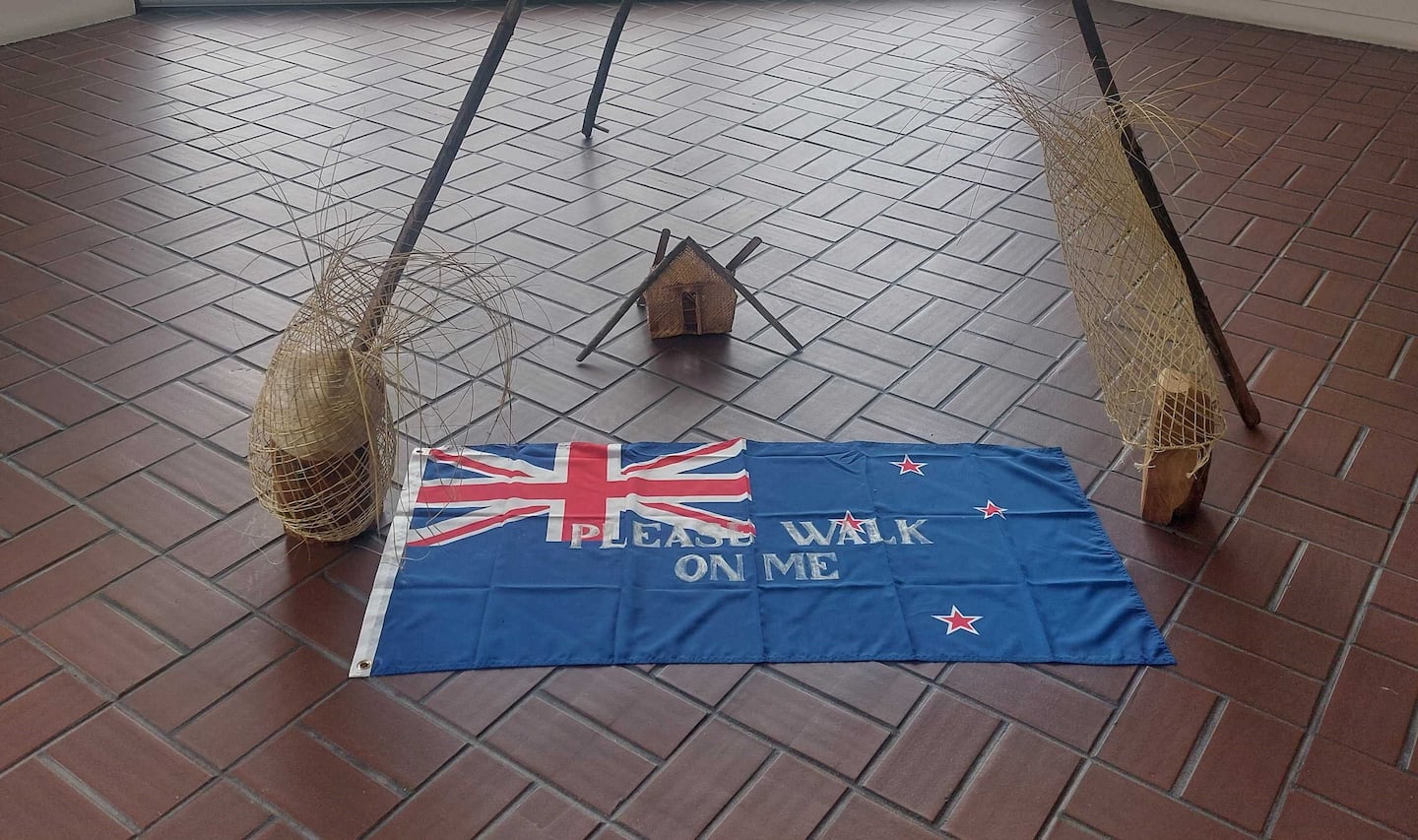
The Te Whare Toi o Heretaunga Hastings Art Gallery is backing a controversial exhibition that encourages people to walk over a New Zealand flag, despite a councillor saying it “feels so wrong”.
Māori artist Diane Prince’s installation Flagging the Future was hastily removed from the Suter Art Gallery Te Aratoi o Whakatū in Nelson earlier this year for what the gallery described as staff safety reasons following abuse and complaints.
The controversial installation includes a New Zealand flag laid on the floor, inviting people to “please walk on me”.
Prince’s exhibit at the Hastings District Council-owned gallery also includes weaving, drawings, paintings, a multimedia installation, and sculptures made over several decades.
Hastings councillor Steve Gibson said seeing the NZ flag on the floor of the gallery with a sign inviting people to walk on it was a real shock.
“That flag has been carried by New Zealanders in every major conflict and it holds deep meaning for many of us,” Gibson said.
“My own feelings come from experience. A friend of mine died while serving in East Timor. I also lost a work colleague who died on duty while we were doing our best to keep our community safe as a police officer.
“My great uncle was killed on the Somme in World War I. When I see our flag, I think of them and the service and sacrifice it represents. That is why treating it in this way feels so wrong.
“It is not about shutting down art. It is about showing respect for something that carries real emotional weight.”
Exhibition curator Gina Matchitt said, on behalf of Prince, the reaction to the installation was like taking “a litmus test of the country”.
“The purpose of it is to unpack dialogue and talk about what the flag means to you,” she said.
“That often depends on your experience and upbringing.
“To many Māori, the flag has a different meaning.”
She said Prince was asking people to walk on it as a form of protest.
“But you don’t have to. It’s a personal choice,” Matchitt said.
She said Prince was a senior Māori artist whose works were a significant part of New Zealand’s art history.
“This exhibition brings together a wide range of her works. Flagging the Future was first presented at the Auckland Art Gallery more than 30 years ago and represents a moment in time when her work prompted deep discussions around New Zealand’s national identity,” Matchitt said.
Gibson said he had raised his concerns within Hastings council because he didn’t want council staff facing the same sort of backlash as the staff at the Nelson gallery experienced.
“We need to be mindful of how these choices affect our people and our community. Especially as our Art Gallery is right next to the war memorial,” Gibson said.
One art gallery visitor contacted Hawke’s Bay Today earlier this week to tell a reporter she had “burst into tears” when she saw the exhibition.
“My father was awarded the Distinguished Flying Cross during World War II,” she said.
“This makes a mockery of his memory. He was proud of what he did for all Kiwis in this country.”
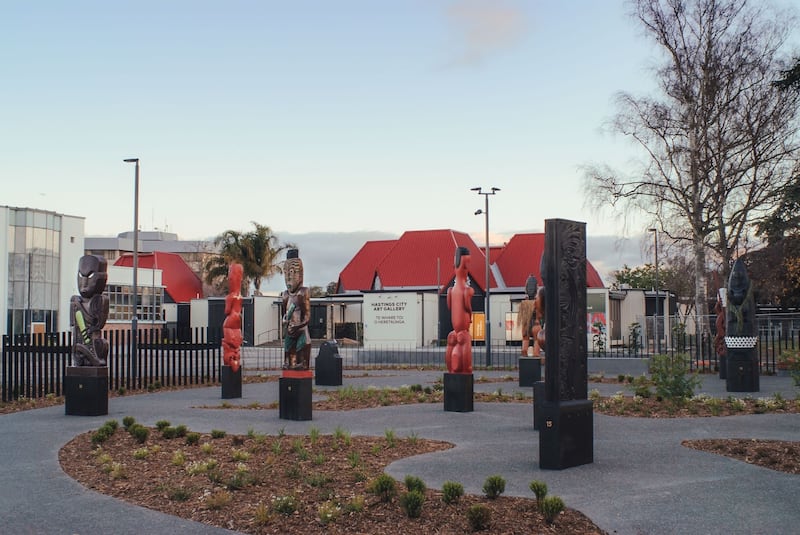
Hastings Art Gallery director Sophie Davis said contemporary art could be confronting, especially when it addressed complex histories of nationhood and experiences of conflict.
“As [is] to be expected, there has been a range of responses and feedback, both positive and negative.
“Many describe the exhibition as powerful and thought-provoking, with some reflecting on how the work made them reconsider their relationship to the flag.
“Others have highlighted the mana of the exhibition, and many people have said the exhibition challenged them but offered new insight.”
Davis said the gallery selected the exhibition based on its cultural significance.
“As a public gallery, our role is to present significant artworks, including those that may be challenging or spark debate.
“Public galleries provide safe spaces for learning, reflection and community conversation. Our role is not to take sides, but to offer context so people can engage and form their own views,” she said.
The exhibition opened at Hastings Art Gallery on November 1 and runs until January 31.
LDR is local body journalism co-funded by RNZ and NZ On Air.