

This story is published through the Indigenous News Alliance.
Although it’s been nearly 20 years since over 100 countries adopted the United Nations Declaration on the Rights of Indigenous Peoples, the rights and lives of those it is meant to protect remain under constant threat from compounding crises. Indigenous lands are battered by record-breaking storms, desiccated by drought, and vanishing under rising seas.
Amid these climate-driven threats, Indigenous peoples continue dying by the hundreds in wars and while defending their lands, even as they are persecuted by government officials.
“Climate change, militarisation, extractivism, and legal marginalisation reinforce one another,” said Binota Moy Dhamai, Tripura from the Chittagong Hill Tracts in Bangladesh, and a former chair of the United Nations Expert Mechanism on the Rights of Indigenous Peoples, or EMRIP.
This week, hundreds of Indigenous delegates are in Geneva at the 19th annual gathering of that United Nations body to find solutions to these abuses and push all countries to more proactively protect Indigenous peoples everywhere.
EMRIP, one of three UN organisations focused exclusively on Indigenous peoples, is composed of seven Indigenous experts, each representing a different region. As part of the U.N. Human Rights Council, they focus on developing data, recommendations, and advice to shape international standards for the fundamental rights of Indigenous peoples and support their enforcement.
This year’s session will see Indigenous leaders, governments, and experts for a week of discussions and debates. Across the week, meetings are expected to cover both longstanding and emerging issues affecting Indigenous peoples, including inadequate disaster relief, artificial intelligence, and resource extraction. For many Indigenous leaders around the world, the stakes could not be any higher, given the overlapping existential threats of violent conflict and climate change.
“Indigenous peoples always face the brunt of conflict,” said Valmaine Toki, who is Māori and the EMRIP member representing the Pacific region.
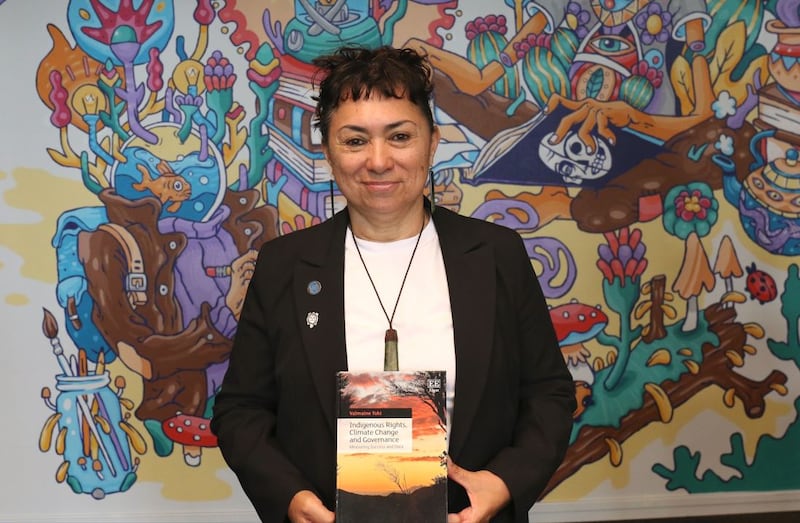
Conflict, she said, leads to the dispossession of and alienation from their traditional lands even as the people from whom they are stolen are drawn into those fights.
“It’s a lose-lose situation for Indigenous peoples on all fronts.”
This year, those gathering in Geneva face a growing list of intersecting issues, including militarisation, climate change, extractive industries, biodiversity decline, and digital transformation, Dhamai said.
For Indigenous peoples in the Pacific, for instance, climate change and colonisation are inextricably linked. Those from the South Pacific nation of New Caledonia have been part of the Pacific-led effort to hold large countries responsible for the crisis and its impact. Viro Xulue, who is Kanak and the Human Rights and Indigenous Rights advisor for the Drehu Customary Council, which is a traditional Kanak governance body, said such work is part of the ongoing fight for true independence. “It’s important for us in the process of decolonisation because it’s to respect the self-determination and what we want for our future, what we want for our children, and what we want to protect our resources, our moana, and our dream for the next generation,” Xulue said.
Despite legal victories like the advisory opinion from the International Court of Justice that countries that contribute to climate change are accountable for the damage it has caused, the Indigenous people of New Caledonia are still fighting for their full rights.

“The inequity for Kanak people is always here since 170 years of colonisation,” Xulue said.
“The injustice is always here for the Indigenous Kanak. They didn’t resolve the problem of colonisation and the impact of the colonisation.”
Although the challenges facing Indigenous peoples vary across regions, those attending EMRIP plan to discuss several common themes. One of them is the ongoing fight for Indigenous involvement in government decision-making. Many countries do not follow international standards, and there is widespread agreement among Indigenous peoples that they should be included in discussions that could impact them and their land.
In northern Ontario, for example, the Canadian government has granted mining rights on the vast wetland ecosystem known as the Breathing Lands. It is part of the Ring of Fire mineral deposit and holds enormous stores of nickel and other valuable metals. It is also a massive carbon sink and a key biodiversity hub. Extraction projects are proceeding despite strong resistance from First Nations in the area, including the Nishnawbe Aski Nation, which represents 49 communities. Kohen Mattinas of Lac Seul First Nation and Constance Lake First Nation is representing Nishnawbe Aski Nation at EMRIP and says that the right of all Indigenous peoples to free, prior, and informed consent must be respected.
Mattinas is also the co-founder of Okiniwak, a youth organisation created in response to Canadian legislation that allows projects to be “advanced through an accelerated process.” In addition to its international advocacy, Okiniwak organises events on Indigenous land. “We’ve taken it upon ourselves to protect the land and our rights on the front lines,” he said.
For Mattinas, attending EMRIP is an important part of that work.
“Through speaking at these international forums, we’re also able to connect with other Indigenous people around the world who are either facing the same things or they face similar things, and we just kind of learn from each other, bring back that knowledge home, or we are able to collaborate in ways to strengthen both of our messaging or our work,” he said.
Those connections can be even more valuable for Indigenous people from countries that do not recognise their legal status, like Botswana. Nichodimas Cooper, who is an Indigenous Nama from that nation, said that the lack of recognition makes it difficult to bring change at the national level.
Cooper said his people face forced assimilation and displacement, and EMRIP offers a unique opportunity to put external pressure on countries.
“We find it as a very important platform that empowers Indigenous peoples like us,” he said.
“We hardly have such a privilege as Indigenous communities to resource ourselves to attend these platforms and be able to inform ourselves on the mechanisms or platforms that are able to make impact within our advocacy’s hope.”
But as Indigenous delegates continue building solidarity, new threats, like artificial intelligence, are emerging. That has led to a push for data sovereignty and stronger protections against technologies being developed without free, prior, and informed consent.

Dhamai said he hopes EMRIP will provide guidance on these emerging issues, alongside climate finance and the global energy transition, because Indigenous perspectives must shape international standards rather than respond to them.
This year’s session is also expected to be shaped by reflections on the approaching 20th anniversary of UNDRIP next year.
For Valmaine Toki, the anniversary is not simply an opportunity to celebrate the Declaration’s adoption but to reflect on the Indigenous leaders whose work made it possible.
“I’m specifically thinking about Moana Jackson and the key role he played in its development,” she said.
Nearly two decades after the declaration’s adoption, the central question facing delegates remains remarkably similar to the one asked in 2007: not whether Indigenous rights should be recognised, but whether governments are prepared to uphold them.
Toki said that although progress can seem slow, EMRIP is important because it gives Indigenous peoples another avenue when domestic systems fail to address their concerns.
“We as Māori have to go to the UN as an avenue to address, highlight and platform our issues,” she said. “It’s about putting peer pressure on member states to do the right thing.”