

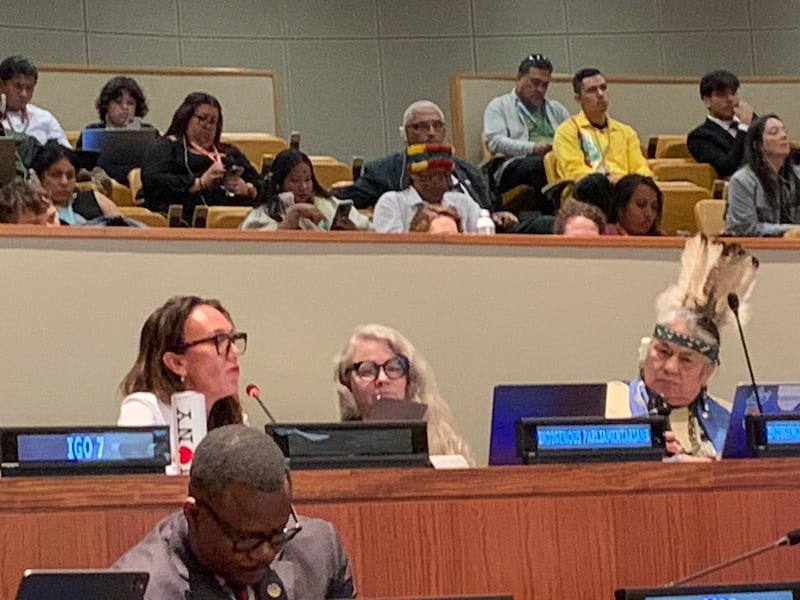
Māori groups and advocates presented concerns about Indigenous rights in Aotearoa to United Nations Special Rapporteur Albert K. Barume at an informal hui in Tāmaki Makaurau on Sunday.
Pou Tikanga, the National Iwi Chairs Forum and the Aotearoa Independent Monitoring Mechanism convened the hui in partnership with the University of Auckland. Organisers said the presentations and discussion would inform a report to the National Iwi Chairs Forum.
Barume is in Aotearoa for an informal academic visit and attended in a personal capacity. This was not an official UN country visit or a formal investigation.

Claire Charters (Ngāti Whakaue, Tuwharetoa, Ngāpuhi and Tainui), who facilitated the visit, said she hoped it would give Barume greater context for the laws and policies affecting Māori.
“I hope he acquires a deeper [understanding] of the breaches of New Zealand’s international obligations to respect Indigenous peoples’ rights,” Charters said.
The hui opened with a mihi whakatau at the James Henare Research Centre, named after Sir James Henare. Michael Steedman (Ngāti Whātua Ōrākei, Te Uri o Hau), kaiarataki in the University of Auckland’s Office of the Pro Vice-Chancellor Māori, welcomed those gathered and shared a whakataukī from the centre’s namesake.
“Kua tawhiti kē tō haerenga mai, kia kore e haere tonu. He nui rawa ō mahi, kia kore e mahi tonu,” it said.
”You have come too far not to go further. You have done too much not to do more,” he said.
Kura Kaupapa Māori seek decision-making authority
Hohepa Campbell, chief executive of Te Rūnanga Nui o Ngā Kura Kaupapa Māori o Aotearoa, presented to Dr Barume. He quoted another whakataukī from Tā Hēmi Henare, “Ko te reo te mauri o te mana Māori.”
“Our language is the foundation of our thinking, identity, belonging, and the transmission of knowledge between generations,” Campbell said.
Te Rūnanga Nui co-chair Rawiri Wright and Renee Wright were also present. Both have dedicated their lives to the kura kaupapa Māori movement.

Campbell asked Barume to seek a formal Government response to the Waitangi Tribunal’s Wai 1718 findings, particularly those on recognising and sharing decision-making authority with Te Rūnanga Nui. He also asked Barume to call on the Government to uphold Article 14 of UNDRIP, which recognises Māori whānau’s right to establish and control their own education systems and institutions.
“These recommendations seek recognition and protection of authority already exercised by our whānau. They do not seek permission from the Crown to exercise that authority. Rather, they ask the Crown to fulfil its obligations under Te Tiriti o Waitangi and international human rights,” Campbell said.
Calls for continued UN engagement
Tina Ngata, lead adviser for the People’s Action Plan Against Racism and Vote for Te Tiriti, spoke about an open letter she co-authored with Leonie Pihama and Tania Waikato after David Seymour publicly rebuked Barume over his letter to the Government. The open letter urged Barume to remain engaged with Māori and invited him to visit Aotearoa. More than 10,000 people had signed it by July 2025.
At the hui, Ngata said the concerns raised in the letter had since deepened, with the Waitangi Tribunal now under threat.

However, she argued the problem extended beyond the current Government.
“This particular government is taking advantage of a weakness that has been created by multiple New Zealand governments and their refusal to adequately protect these human rights and Treaty rights and Indigenous rights mechanisms,” she said.
Ngata asked Barume to respond in writing to the letter, continue using his communications procedure with the Government, include the issues in his next report to the Human Rights Council, and raise them at the next UN Permanent Forum on Indigenous Issues. She also suggested using his upcoming Nin Tomas Memorial Lecture to address what abolishing the Waitangi Tribunal would mean for Māori access to effective remedies.
She added a further request for Barume to support efforts to obtain a response from the UN Committee on the Elimination of Racial Discrimination to an Early Warning and Urgent Action request submitted by her group and Lady Tureiti Moxon.
Whānau struggle to access returned whenua
Naomi Watts presented the Ihaia Taueki Trust’s efforts to reconnect whānau with whenua returned to the hapū in 2012. Over the past two years, the trust has been reconnecting whānau, regenerating the whenua, writing a new trust deed grounded in its practices, and helping whānau through succession.
“We are not waiting for the Crown,” she said.

She described the work of her hapū as being self- determination in practice, but the trust’s plans depend on secure title, access to the land and laws that recognise the hapū, Watts said. The whenua remains landlocked, and the trust has been told it owes about $40,000 in rates. The whānau cannot get onto the land to protect or restore it.
“When land finally comes home, it comes with a bill and no road in,” she said.
We have tried to ask for permission from the surrounding farmers, all of whom are not Indigenous, and they do not want to play ball and want nothing to do with us, so we cannot access that land to protect it.
She asked Barume to include the trust’s experience in his work on Indigenous land rights, consider a future official visit to Aotearoa that could include smaller trusts, continue raising the Treaty Clause Review with the Government, and support independent Māori monitoring through Pou Tikanga, AIMM and the National Iwi Chairs Forum.
The trust also called on the Government to halt the Treaty Clause Review, restore Māori wards and Māori-led institutions, and adopt a national action plan to implement UNDRIP.
Cost-of-living pressures and Māori underemployment
Tania Pouwhare spoke from two roles - Chief Executive of Good Shepherd New Zealand, which supports people facing financial hardship, and Kaihautū of Ngā Toki Whakarururanga, which works on Māori interests in trade policy.
“There are people in this room who fought and won those battles in the 70s and 80s, and yet here we are. What has shocked me is how quickly things have been allowed to unravel,” Pouwhare said, reflecting on the rapid changes she’d seen under the current government.

She said 14,000 people contact the organisation each year for help. She also pointed to Māori unemployment of 11.5 per cent and underutilisation of 25 per cent, saying the latter figure did not include people who had stopped looking for work.
Pouwhare described hardship among older women who were still caring for children but lacked basic services, including hot water and adequate sewerage facilities
“Underutilisation in this country is perhaps the most nefarious and most unseen dynamic of our labour market,” she said.
Speaking for Ngā Toki, she cited the New Zealand–India free trade agreement as an example of Māori having limited influence over trade negotiations. Ngā Toki’s published assessment says it could not review the negotiating text before the agreement was signed because India would not allow it to be shared. It also says MFAT and Ngā Toki had agreed on a stronger Te Tiriti protection for the deal, but the final agreement retained the older Treaty exception instead.
The final agreement does affirm UNDRIP. Ngā Toki’s assessment raises concerns about the agreement’s limited recognition of Indigenous peoples and the lack of guaranteed Indigenous participation.
Development proposals raise questions about hapū representation
At the heart of David Mercer’s presentation was a question of who gets to speak for the whenua when major developments are proposed.
Mercer (Ngāti Whātua, Te Taoū) raised concerns about the Wayby Valley landfill in Dome Valley and the proposed Pukeatua development, including potential effects on waterways and culturally significant places, and on hapū authority.
The landfill dispute has also exposed tensions over representation. Ngāti Manuhiri Settlement Trust reached an agreement with Waste Management and changed its position on the proposal. Later, Ngā Maunga Whakahī o Kaipara Development Trust, Te Rūnanga o Ngāti Whātua and Te Uri o Hau Settlement Trust withdrew their opposition from the legal process.
Pūtahi Marae, one of the five South Kaipara marae associated with Ngā Maunga Whakahī, has opposed the landfill. Kahurangi Naida Glavish said Pūtahi did not feel adequately represented in the decision.

Ngā Maunga Whakahī is a post-settlement governance entity responsible for managing assets returned through the Ngāti Whātua o Kaipara settlement.
Its own website says the marae and their associated lands are independent and not under the trust’s authority. That distinction sits at the centre of the call made at the hui for direct engagement with affected hapū and marae, rather than relying on a settlement entity to speak for every community.
Glavish supported Mercer’s presentation and linked the land concerns to a prophecy she attributed to Āperahama Taonui.
“He taniwha kei te haere mai - ōnā niho he hiriwa me te kōura, ko tōna kai he whenua. Kaua e mataku i te hiriwa me te kōura, engari kaua e tuku i te hiriwa me te kōura hei atuatanga mōu,” she said he had warned.
“There is a demon on its way. It is a demon that will arrive with teeth of silver and gold and an insatiable diet for land. Fear not the teeth of silver and gold. Just do not allow it to become your God.”
The presentation called for direct engagement with affected hapū and marae, independent assessments of environmental and cultural impacts, and greater transparency around consenting. It also sought scrutiny of fast-track processes and compulsory acquisition, and consideration of an independent Treaty and Indigenous Rights Commissioner.

Wider UN engagement and the debate over UNDRIP
The concerns raised at the hui sit within a wider debate about Indigenous rights, constitutional change and Aotearoa’s engagement with the United Nations.
The Expert Mechanism on the Rights of Indigenous Peoples (EMRIP) is an independent group of experts that advises the UN Human Rights Council. During a 2019 country engagement, it provided advice to the Government and Māori on developing a national plan to implement UNDRIP.
By July 2025, the Government had not responded to EMRIP’s request for a follow-up. Since then, EMRIP has continued its dialogue with New Zealand. A follow-up country engagement has been accepted and is proposed for early 2027.
Discussions about implementing UNDRIP have also continued in Aotearoa. A Government-commissioned working group produced He Puapua, a report offering options for putting the Declaration into practice. The Government did not adopt it as policy.
The report has returned to public debate after Opportunity Party MP-elect Dr Kayla Kingdon-Bebb, a co-author, defended it in a TVNZ Q+A interview and called for a constitutional conversation “in a really measured, considered and inclusive way.”
Preliminary election results place her among the Opportunity Party’s seven list MPs, although the official results are due on 27 November.
New Zealand has also abstained from a recent UN General Assembly resolution on Indigenous Peoples’ participation in UN meetings. The Government said its decision reflected its position that UNDRIP is non-binding, and its view that New Zealand’s existing legal and constitutional framework defines how it engages with the Declaration.